
Print
Cite
Feedback
Share
Nineteen Eighty-Four, published on 8 June 1949 by Secker and Warburg, is George Orwell’s account of a society in which the state has abolished private life, rewritten the past, and reduced language to a tool for preventing thought. Conservatives read it as the sharpest warning in English about what happens when the abstractions of revolutionary politics are permitted to override inherited custom, family loyalty, religious conscience, and the plain meaning of words.
The novel matters to conservatism less as a prophecy about surveillance technology than as an argument about truth. Winston Smith’s job at the Ministry of Truth is to destroy the record of what actually happened. Orwell’s claim is that a regime built on a total theory of history must control memory, because memory is where inherited obligation lives.
Key Takeaways
- Orwell finished the novel on the Scottish island of Jura in 1948 and died of tuberculosis in January 1950, seven months after publication.
- The appendix, “The Principles of Newspeak,” argues that shrinking vocabulary destroys the capacity for dissent before dissent can be spoken.1
- Orwell was a lifelong socialist who wrote against Stalinism, not against the welfare state; he said as much in 1946.2
- Conservative readers draw on the book for its defence of objective truth, private affection, and the memory of a real past against ideological revision.
- The novel’s targets — the Party’s monopoly on history, its war on the family, its abolition of privacy — map onto the conservative account of what totalitarian politics destroys first.
History And Context
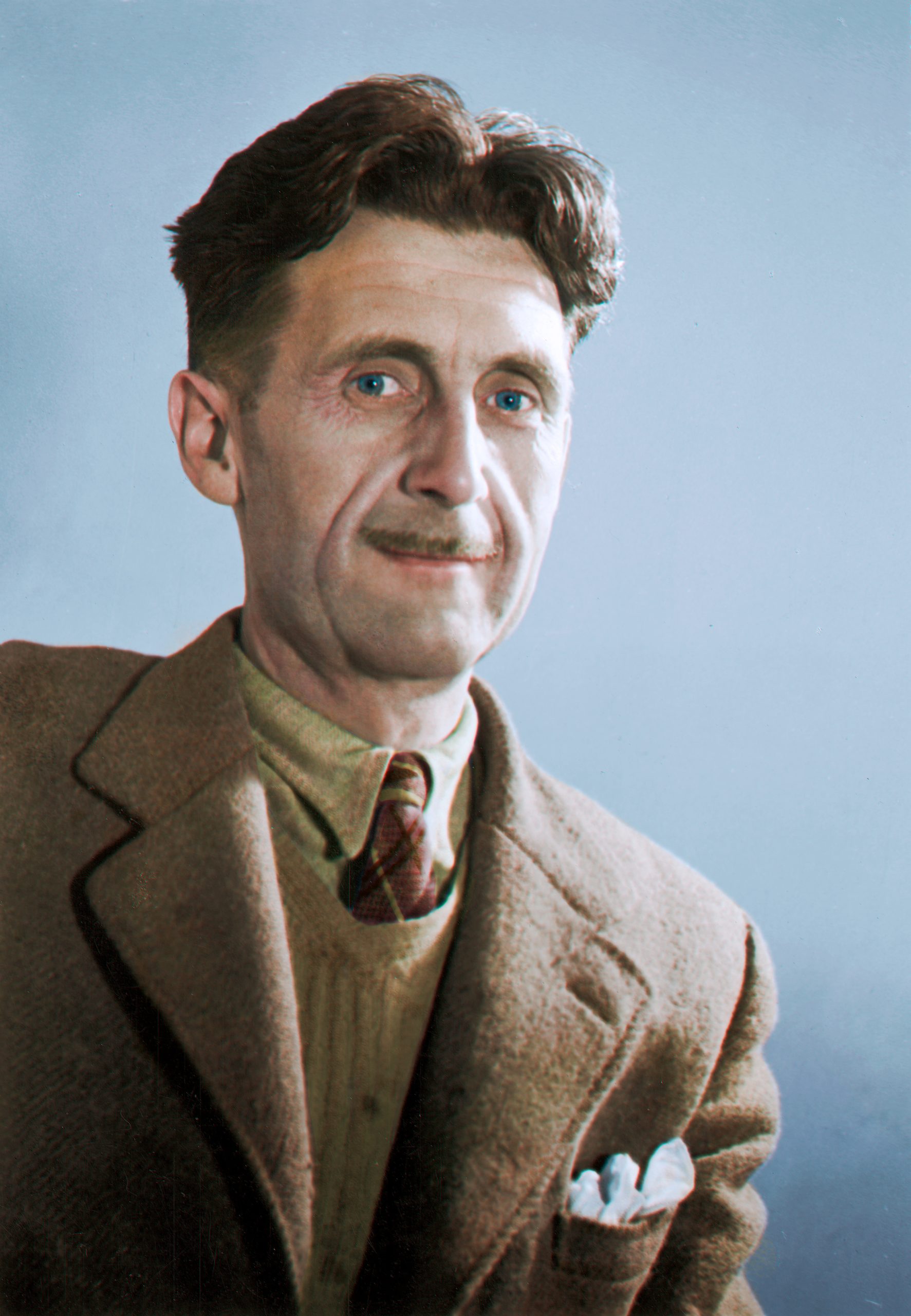
Orwell’s political education came from defeat. He went to Spain in December 1936, fought with the POUM militia on the Aragon front, was shot through the throat in May 1937, and then watched Communist forces in Barcelona brand his own comrades as fascist agents. Homage to Catalonia (1938) recorded the experience that shaped everything after it: the press reported battles that had not happened and erased ones that had.
Animal Farm, rejected by four publishers and finally issued in August 1945, made the case in fable. Nineteen Eighty-Four made it in earnest. Orwell drew on Yevgeny Zamyatin’s We (1924), which he reviewed in 1946, and on James Burnham’s The Managerial Revolution (1941), whose thesis about a permanent administrative elite he criticised in “Second Thoughts on James Burnham” that same year. He had reviewed Hayek’s The Road to Serfdom for the Observer in April 1944, agreeing with its warning about collectivism while rejecting its economics.
The Ministries of Truth, Peace, Love, and Plenty were drawn from wartime London, where Orwell had worked in the BBC Eastern Service from 1941 to 1943. Room 101 took its name from a conference room in Broadcasting House. The book is a report from inside the machinery of state information, not a fantasy about a distant future.
The Conservative Position
Conservatives take three lessons from the novel.
First, that truth is not the property of the state. Hayek made the same argument in the chapter of The Road to Serfdom he titled “The End of Truth”: a planned society requires agreement on ends, and agreement on ends requires control of what counts as fact.3 Orwell dramatised it. O’Brien’s demand that Winston see five fingers is not a metaphor for lying; it is a claim that reality is whatever collective power says it is.
Second, that the family, the church, the friendship, and the private room are the load-bearing walls of a free society. The Party attacks each one deliberately — children informing on parents, the Junior Anti-Sex League, the telescreen in the bedroom. Roger Scruton argued that conservatism is the defence of these inherited attachments against the claim that political theory can supply better ones.4 Orwell’s Party has no rival institutions, and that absence is the point.
Third, that language is a possession held in trust. Newspeak works by subtraction: fewer words, narrower meanings, and heresy becomes literally unsayable. Conservatives apply this to any attempt to compel or redefine ordinary speech, on the grounds that a vocabulary policed for political ends is a vocabulary that no longer permits the argument.
The novel also refuses the consoling idea that tyranny is a means to some further end. O’Brien states the Party’s purpose plainly: power, pursued for itself. That flatly denies the utopian premise that suffering now purchases justice later.
Differing Positions
Orwell’s defenders on the left object that conservatives have annexed a socialist. The objection has force. Orwell wrote in 1946 that every serious line he had produced since 1936 was written against totalitarianism and for democratic socialism as he understood it.2 He supported the Attlee government and aimed his fire at the Soviet Union and its apologists in the British intelligentsia. On this reading, Nineteen Eighty-Four is an argument for socialism cleansed of Stalinism, not against socialism.
A second objection holds that the novel has been flattened into a slogan. “Orwellian” now attaches to any disliked policy, which drains the word of its specific meaning: the deliberate, systematic falsification of the record by a one-party state. Critics on both flanks note that a book invoked reflexively stops being read.
Conservatives answer that the argument survives its author’s intentions. Orwell showed what a state does when it claims authority over history, language, and private affection. Whether the state calls itself socialist, nationalist, or technocratic changes nothing about the mechanism he described.
References
- George Orwell, Nineteen Eighty-Four (Secker and Warburg, 1949), appendix, “The Principles of Newspeak.”
- George Orwell, “Why I Write,” Gangrel, no. 4 (Summer 1946).
- F. A. Hayek, The Road to Serfdom (Routledge, 1944), ch. 11, “The End of Truth.”
- Roger Scruton, The Meaning of Conservatism (Penguin, 1980), ch. 1.
You've read articles over the past year
Will you support conservative education?
A gift of any amount helps keep unique explanatory journalism free for all, and
supports our mission to help everyone understand the world, regardless of their
ability to pay.One-time contributors join our community of givers and will be kept
up to date on the journalism that you help keep free.

Nineteen Eighty-Four
Nineteen Eighty-Four, published on 8 June 1949 by Secker and Warburg, is George Orwell's account of a society in which the state has abolished private...

Centesimus Annus
Centesimus Annus ("In the Hundredth Year") is the encyclical issued by Pope John Paul II on 1 May 1991, eighteen months after the fall of...

Quadragesimo Anno
Quadragesimo Anno ("In the Fortieth Year") is the social encyclical issued by Pope Pius XI on 15 May 1931 to mark the fortieth anniversary of...

Rerum Novarum
Rerum Novarum ("Of New Things") is the encyclical issued by Pope Leo XIII on 15 May 1891 in response to the social crisis produced by...