
Print
Cite
Feedback
Share
Key Takeaways
- Huxley’s dystopian novel illustrates and criticises both rationalist and big state models of society.
- In particular, the book condemns concepts such as central planning, unrestrained consumerism, absolute liberty and the erosion of the family.
- Brave New World tacitly advocates a reasonable middle ground: a government large enough to maintain order but which is sufficiently restrained in size and scope to allow for individual expression.
Introduction
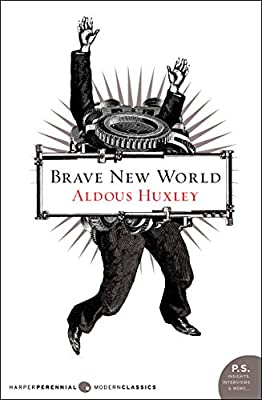
Brave New World is a dystopian novel by Aldous Huxley. Set 500 years in the future, it warns against a society in which the state controls all aspects of life from birth to death. Notably, in the same book Huxley also criticizes the extreme opposite of this: anarchy and surrender to unfettered emotion. Published in 1932, Brave New World has continued to influence politicians, philosophers and creatives for almost a hundred years.
The Novel
Would the world be better if everything was decided for you? In Huxley’s dystopia, the state manages every aspect of life, from birth to death, based on cold rationality and absolute utility. The author contrasts this world with that of a leaderless society of ‘savages’, where the heart rules the head. Huxley argues against both extremes, implicitly expressing a preference for a reasonable middle ground capable of both maintaining social order while allowing for human expression.
In Huxley’s world, sexual reproduction has been replaced by laboratories where people are created in test tubes. Lab technicians carefully manipulate each one to suit a predetermined function, even down to dictating a person’s dexterity in accordance with their allotted role. Five classes of person are produced: alphas are privileged with the most intelligence, betas are second best, then deltas and gammas, down to the unfortunate oxygen-starved epsilons. Their caste notwithstanding, all people are taught to be content with their lot.
Classroom education, conditioning through sleep, propaganda, and a drug called soma lulls everyone into acquiescence. Without the need to reproduce naturally, emotional relationships are banned and sex is plentiful. Even rape is accepted to keep broader society quiescent. Economic stability also promotes social harmony: the state tells its citizens what they should want, enjoy, and create, keeps supply and demand in check, and eliminates the need for money completely. Lastly, people no longer fear death, having been taught since they were children to associate it with chocolate.
Outside of this expansive state is the savage reservation. The savages are seemingly leaderless, lack organization, and are riddled with disease and hardship. Here, conception and birth take place naturally, producing people who have to figure out their own place in the community. One savage named John is extracted from this community and put on show in the other world. He becomes outraged at what he sees, preferring instead to be led by intuition, emotion, and works of literature.
In its final section, the story turns into a tale of unrequited love. At the same time as John becomes growingly frustrated with the world, he becomes increasingly fixated with Leena, a devotee of the new world. John confesses his feelings for Leena but Leena cannot comprehend what love is. Wedded to the conveniences of her hyper-controlled life, she dismissed his pledges of devotion saying that robots can compete such service tasks. There is not a happy ending.
Political Philosophy in Brave New World
Leena’s world embodies concepts associated with the logical extremes of rationalism. The role of the family to produce and raise children has been replaced by the test tube babies of scientific laboratories.[1] Broader society has been supplanted by conditioning and propaganda. In their place, management concepts such as Taylorism, which aims to infuse operational workflows with the scientific method, and Fordism, where each worker is allotted a single task to repeat, make individual liberty redundant.[2] This society is maximally controlled and forcibly as efficient as possible. Echoing the political philosophy of utilitarianism, most closely associated with the philosopher John Stewart Mill,[3] the individual’s will is always subservient to the collective good. Even the most basic liberty to make decisions about oneself, one’s body and one’s life is subsumed by this domineering government and its all-encompassing decision-making power. Huxley certainly does not advocate this model.
In contrast, the savage reservation is marked by disorder, meaninglessness, illness, and early death. The absence of institutions and social structures strikes the reader as chaotic. Although Huxley does not describe the savage reservation in as much detail, it is nonetheless clear that the savage reservation does not represent his ideal form of society either.
What does Huxley advocate? John displays unfettered emotion and his upbringing in the savage reservation lacks order completely. In contrast, Leena has abandoned her individuality to the state which maintains utter control over the world. Huxley recommends neither of these two extremes. However, we can confidently conclude that Huxley believed the following:
- Leena and John’s worlds both represent bad types of governance.
- A totalitarian government that leaves no room for liberty is inhuman.
- At the same time, no society can function without some sort of organization.
Conservative Perspective
Brave New World illustrates through fictionalization many concepts that conservatives argue against. This enables the reader to explore the potentially damaging consequences of such ideas in an accessible way. Also, practically speaking, the conservative may point others to Brave New World in order to understand the deficiencies of these concepts.
Conservatives place a high value the capacity of human beings to make their own choices as well as treasuring the role of institutions in providing guidance, meaning and goals to society as a whole. Brave New World shows the repugnant consequences of having a state so large that it overtakes individual choice and becomes the only institution in existence.
On economics, the conservative would note the absence of economic choices with the state controlling production, demand and employment. Further, in the absence of a unit of exchange, citizens are wholly reliant upon the state to provide. In particular, the conservative will view Brave New World as an implicit criticism of the planned economy. A planned economy is one in which the state centrally controls production and consumption, theoretically keeping the two in check. This idea experienced rapid popularity across Soviet states around the time Huxley was writing his novel and was later adopted across other communist countries in Asia, too. As Huxley forewarned, no model has ever proved workable in the real world. Moreover, for the conservative, the planned economy dispenses with that most foundational principle: the role of agency.
The social conservative reading the book would note the destruction of the traditional family and the supplantation of the normal role of society in socialising the young. Without familial and ordinary interpersonal relationships, love and friendship have been forgotten. To the social conservative, Brave New World underscores the value of the family and social relationships.
Lastly, with regards to the savage reservation, the conservative must balance choice against the practical necessity of maintaining institutions and traditions that uphold broader society. The savage world illustrates what happens when structure is abandoned in its entirety. Echoing the sentiment of one of Huxley’s contemporaries, the philosopher Bertrand Russell argued that although values and the very concept of society are indeed constructs, to be without some construct is sheer anarchy.[4] Huxley uses a literary device – John’s demise – to condemn this picture.
In summary, the conservative rejects big government as overbearing and cumbersome, unable to accommodate human agency and fated to fail in its mission to control society completely. Yet the conservative does not want there to be no government whatsoever, for people still need organisation and protection from each other. Brave New World reminds the conservative why these two extremes are so objectionable and offers a persuasive means of informing others, too. A small government that allows for liberty and upholds continuity through traditions and institutions is, therefore, optimal, accommodating of human nature and implicitly argued for in Brave New World.
Context and Legacy
Huxley was enormously influenced by a trip to America. There, the author was shocked by American consumerism and mechanisation. Huxley borrowed the assembly-line techniques propagated by Henry Ford in Detroit and applied these to his imagining of the social order in Brave New World. He also applied the stereotypically American ‘throw away’ culture to human beings, using this concept as a lens through which to explore the value of human beings themselves. Apart from his American influences, Huxley was also interested in the crossovers between science, psychology and humanity, in particular the works of Sigmund Freud and Ivan Pavlov. In particular, Huxley found the concept of conditioning particularly frightening and dehumanising, exploring these ideas in Brave New World.
Brave New World has had a lasting impact on popular culture. It has been adapted for stage, radio, television and film several times. The phrase ‘brave new world’ has entered the popular lexicon. Though arguably less famous than some other works of dystopian fiction, Brave New World nonetheless stands as a classic of the genre.
Further Reading
Huxley also wrote an extended essay called Brave New World Revisited, which reviewed his earlier novel, and penned a utopian fiction counterpart, Island, which was published in 1962 shortly before his death.
In addition to Huxley’s works, the wider dystopian fiction genre contains countless novels that explore different conceptions of the imperfect – often totalitarian – state through the medium of literary fiction. The Russian dystopian novel We by Yevgeny Zamyatin, first published in English in 1924, has frequently been compared to Brave New World and shares many commonalities including a pervading criticism of state overreach. George Orwell – who was a student of Huxley’s while at Eton – wrote one of the world’s most famous dystopias, Nineteen Eighty-Four, which similarly examines the tyranny of an all-seeing state. Another similar work is Ray Bradbury’s Fahrenheit 451, which focuses on the control and extermination of certain aspects of culture. Lastly, one of the earliest works of dystopian fiction, Sir Thomas More’s Utopia (an ironic title) also grapples with the ills of a domineering state.
- [1] Miller, Gavin. 2018. “Political Repression and Sexual Freedom in Brave New World and 1984,” in Huxley’s Brave New World: Essays, ed. David Garrett Izzo and Kim Kirkpatrick (Jefferson, North Carolina: McFarland & Company, Inc., Publishers), 62–72.
- [2] Peller, Scott. 2018. “Labouring for a Brave New World: Our Ford and the Epsilons,” in Huxley’s Brave New World: Essays, ed. David Garrett Izzo and Kim Kirkpatrick (Jefferson, North Carolina: McFarland & Company, Inc., Publishers), 67.
- [3] Mill, John Stuart. 2015. "On Liberty, Utilitarianism and Other Essays." Oxford: Oxford University Press,[1863].
- [4] Russell, Bertrand. 2018. "The Scientific Outlook." Cornwall: Routledge Classics,[1931].
You've read articles over the past year
Will you support conservative education?
A gift of any amount helps keep unique explanatory journalism free for all, and
supports our mission to help everyone understand the world, regardless of their
ability to pay.One-time contributors join our community of givers and will be kept
up to date on the journalism that you help keep free.

Nineteen Eighty-Four
Nineteen Eighty-Four, published on 8 June 1949 by Secker and Warburg, is George Orwell's account of a society in which the state has abolished private...

Centesimus Annus
Centesimus Annus ("In the Hundredth Year") is the encyclical issued by Pope John Paul II on 1 May 1991, eighteen months after the fall of...

Quadragesimo Anno
Quadragesimo Anno ("In the Fortieth Year") is the social encyclical issued by Pope Pius XI on 15 May 1931 to mark the fortieth anniversary of...

Rerum Novarum
Rerum Novarum ("Of New Things") is the encyclical issued by Pope Leo XIII on 15 May 1891 in response to the social crisis produced by...