
Print
Cite
Feedback
Share
Liberty, in political philosophy, denotes the condition of being free from external constraint or coercion, though thinkers have long disagreed over what kind of freedom the word should name. Isaiah Berlin’s 1958 lecture “Two Concepts of Liberty” gave the debate its modern shape by distinguishing negative liberty, freedom from interference by others, from positive liberty, the capacity for self-mastery and self-realization, a distinction that continues to structure conservative and classical liberal argument about the proper scope of the state. Conservative and libertarian traditions have favored negative liberty as the primary political good, treating the state’s central task as removing obstacles to individual action rather than directing individuals toward any particular vision of the good life.
Key Takeaways
- Isaiah Berlin’s distinction between negative liberty, freedom from interference, and positive liberty, freedom to achieve self-mastery, remains the standard reference point in debates over the proper meaning of political freedom.
- Classical liberal and libertarian conservatives, following Friedrich Hayek and Milton Friedman, treat negative liberty and free markets as mutually reinforcing, arguing that economic freedom is a precondition for political freedom.
- Traditionalist conservatives, including Edmund Burke and Russell Kirk, have argued that liberty is meaningful only within a framework of ordered custom, law, and inherited institutions, rejecting liberty defined as pure absence of restraint.
- The English constitutional tradition, running from Magna Carta in 1215 through the 1689 Bill of Rights, is treated by many conservatives as the historical vehicle through which liberty was secured incrementally rather than through abstract declaration.
- Positive liberty theories have drawn conservative criticism for their historical association with regimes that claimed to liberate citizens by directing them toward a collectively defined good, sometimes coercively.
History And Context
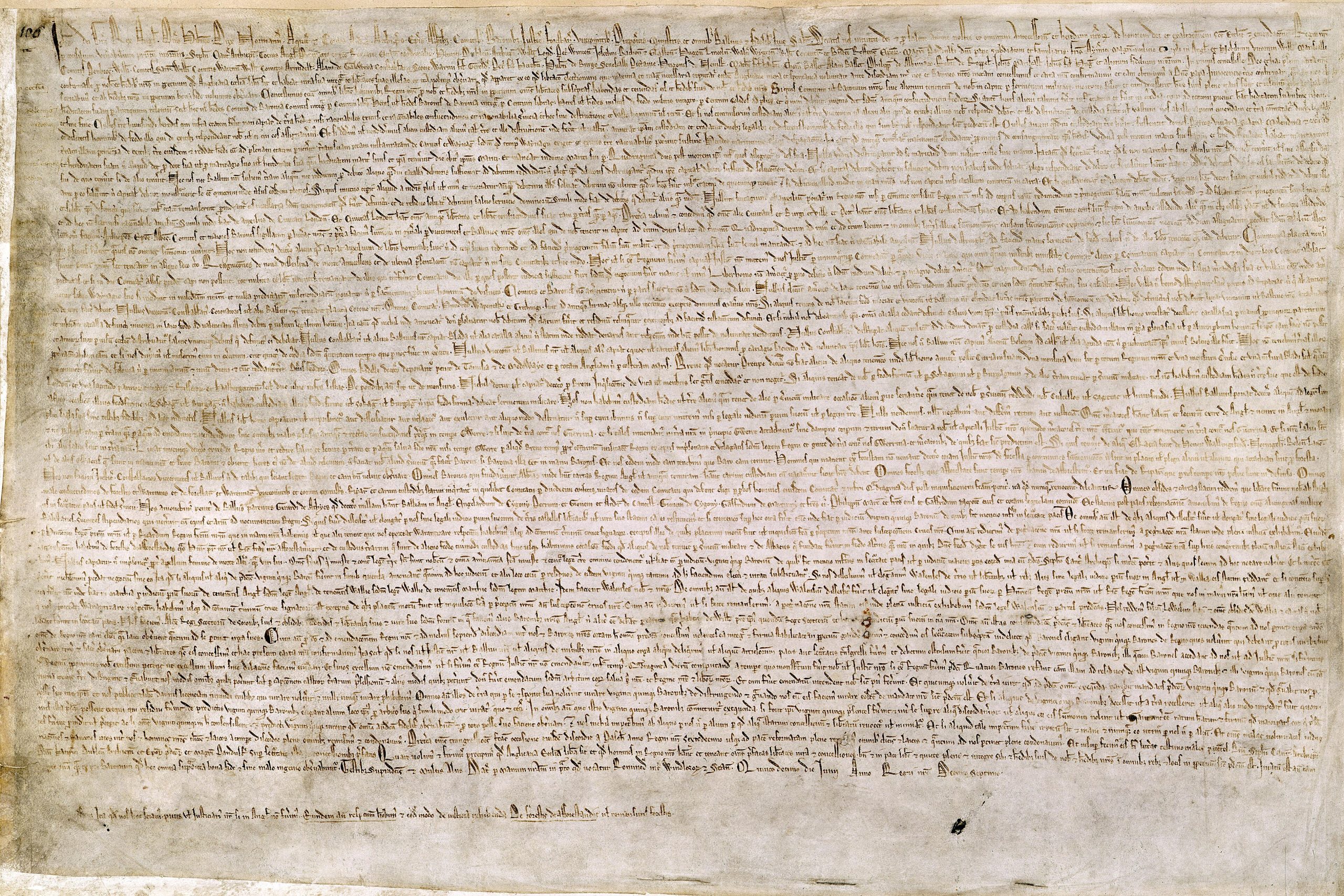
The English tradition conservatives cite as the practical origin of liberty in the Anglo-American sense begins with Magna Carta, sealed by King John at Runnymede in June 1215, which established that the monarch’s power was subject to law rather than absolute, even though its immediate provisions protected baronial privilege more than individual freedom in the modern sense. The English Civil War of the 1640s and the Glorious Revolution of 1688 extended this constitutional constraint on executive power, culminating in the Bill of Rights of 1689, which barred the Crown from suspending laws or raising taxes without parliamentary consent. John Locke’s Two Treatises of Government, published in 1689 to justify the Glorious Revolution, articulated a theory of liberty grounded in natural rights and government by consent that influenced both British Whig politics and, a century later, the American founding. Edmund Burke, writing in the 1770s in support of American colonial grievances and later against the French Revolution, distinguished what he called the liberty of the English, concrete, inherited, secured through precedent and constitutional practice, from the abstract liberty proclaimed by French revolutionaries in 1789, a distinction that became foundational to later conservative thought. Isaiah Berlin’s 1958 inaugural lecture at Oxford, delivered during the Cold War and published as “Two Concepts of Liberty,” reframed this older debate in explicitly analytic terms, arguing that positive liberty’s demand for rational self-mastery had, in totalitarian hands, licensed political domination in the name of liberating the individual’s “true self.”
The Conservative Position
Classical liberal and libertarian conservatives, following Friedrich Hayek’s The Constitution of Liberty (1960) and Milton Friedman’s Capitalism and Freedom (1962), treat negative liberty as the central political value and argue that economic freedom, security of property, and freedom of contract are inseparable from political freedom, since concentrated economic power in state hands produces concentrated political power. Traditionalist conservatives in the Burkean line take a different approach, arguing that liberty divorced from custom, religious inheritance, and settled law degenerates into license, and that ordered liberty, freedom exercised within a framework of moral and legal restraint built up over generations, is the kind of liberty that has proven durable. Russell Kirk’s The Conservative Mind (1953) presents this ordered-liberty view as the thread connecting Burke to later American conservatives, arguing that the French Revolution’s abstract liberty produced the Terror precisely because it discarded the restraining institutions that had made English liberty stable. Both strands converge on skepticism toward positive liberty as a state project, arguing that any government empowered to define and impose a citizen’s “true” freedom acquires, in practice, unlimited authority to override the citizen’s actual choices.
Differing Positions
Left-liberal and social-democratic critics argue that negative liberty alone is an insufficient or even misleading standard, since formal freedom from interference means little to a person lacking the material resources, education, or health to exercise it meaningfully; on this view, positive state action to secure a baseline of capability is a precondition for liberty rather than a threat to it, a position associated with philosophers such as T.H. Green in the nineteenth century and, later, Amartya Sen’s capability approach. Critics of Berlin’s framework itself, including philosopher Gerald MacCallum, have argued that the negative-positive distinction collapses under analysis, since every claim about freedom implicitly specifies an agent, a constraint, and a goal, making the “negative” and “positive” framings two descriptions of the same underlying structure rather than genuinely rival concepts. Conservatives respond that even if the philosophical distinction is imperfect, the historical record of governments that invoked positive liberty to justify coercive social engineering, from Jacobin France to twentieth-century single-party states, supplies sufficient practical reason to keep negative liberty as the operative default in constitutional design.
References
- Isaiah Berlin, “Two Concepts of Liberty,” in Four Essays on Liberty (Oxford University Press, 1969).
- Friedrich A. Hayek, The Constitution of Liberty (University of Chicago Press, 1960).
- Edmund Burke, Reflections on the Revolution in France (1790).
- Russell Kirk, The Conservative Mind: From Burke to Santayana (Regnery, 1953).
- Milton Friedman, Capitalism and Freedom (University of Chicago Press, 1962).
- [1] Chamberlain, Paul Wilson. 1990. “The Development of the Concept of Liberty in British Philosophy from 1640 to 1863: Hobbes, Locke and Mill.” Dissertations (1962 - 2010) Access via Proquest Digital Dissertations, January, 1–328. https://epublications.marquette.edu/dissertations/AAI9101412/.
- [2] Clark, Grenville. 1938. “Conservatism and Civil Liberty.” American Bar Association Journal 24: 640. https://heinonline.org/HOL/LandingPage?handle=hein.journals/abaj24&div=192&id=&page=.
- [3] Goldsmith, M.M. 2000. “REPUBLICAN LIBERTY CONSIDERED.” History of Political Thought 21 (3): 543–59. https://www.jstor.org/stable/26219720.
You've read articles over the past year
Will you support conservative education?
A gift of any amount helps keep unique explanatory journalism free for all, and
supports our mission to help everyone understand the world, regardless of their
ability to pay.One-time contributors join our community of givers and will be kept
up to date on the journalism that you help keep free.

Westernization
Westernization is the adoption by non-Western societies of institutions, technologies, laws, manners and habits of mind that originated in Western Europe and its colonial offshoots....
War Crime
A war crime is a serious violation of the law of armed conflict for which an individual bears personal criminal responsibility. The category covers the...

Voter ID Laws
Voter identification laws require a person presenting to vote to prove who they are, usually by producing a government-issued document. The requirement is unremarkable across...

Voter Fraud
Voter fraud is the deliberate corruption of an election by unlawful means: impersonating another voter, casting ballots in the name of the dead or the...