
Print
Cite
Feedback
Share
A war crime is a serious violation of the law of armed conflict for which an individual bears personal criminal responsibility. The category covers the deliberate killing of prisoners, the targeting of civilians and civilian objects, the taking of hostages, the use of prohibited weapons, pillage, and the perfidious use of protected emblems. It is distinct from the question of whether a war was just to begin with: a soldier fighting in a righteous cause who executes prisoners has committed a war crime, and a soldier fighting in an unjust one who observes the rules has not.
Conservatives have a long and mostly proprietary relationship with this body of law. It grew out of the Christian just-war tradition and the professional honour codes of European officer corps, not out of twentieth-century humanitarianism, and its oldest formulations are conservative in structure: restraint on the strong, protection of the defenceless, and rules binding on both sides regardless of the merits of the quarrel. The modern conservative dispute concerns enforcement — who tries the accused, under whose authority, and answerable to whom.
Key Takeaways
- The idea that combat is governed by rules binding on all parties comes from the just-war tradition of Augustine and Aquinas and from Hugo Grotius’s systematic treatment of 1625.
- The first modern codification was American and wartime: the Lieber Code, issued to Union armies as General Orders No. 100 in April 1863.
- Nuremberg established individual criminal liability under international law in 1945-46 and rejected superior orders as a complete defence.
- The Geneva Conventions of 12 August 1949 created the category of grave breaches and obliged every signatory state to search for and prosecute offenders.
- Conservative criticism of the International Criminal Court is jurisdictional rather than permissive: the objection is to a supranational prosecutor unaccountable to any electorate, not to the prohibitions themselves.
History And Context

Augustine argued in the fifth century that a Christian could fight without sin under conditions of right authority, just cause and right intention. Aquinas systematised the conditions in the thirteenth century. Medieval chivalric practice added enforceable customs — ransom, quarter, safe-conduct, the immunity of clergy and pilgrims — enforced by courts of chivalry and by the reputational economy of the knightly class.
Grotius wrote De Jure Belli ac Pacis in 1625, amid the Thirty Years War, and grounded the law of nations in a natural law he argued would hold even on the impossible supposition that God did not exist.1 His claim that sovereigns at war remain bound by law is the foundation of everything that follows.
Codification began in the American Civil War. Francis Lieber, a Prussian-born veteran of Waterloo who taught at Columbia and had sons fighting on both sides, drafted a field code for Lincoln’s armies. Issued as General Orders No. 100 in April 1863, it prohibited torture, protected prisoners and civilians, and stated plainly that military necessity does not licence cruelty. European powers copied it. The Hague Conventions of 1899 and 1907 followed, carrying the Martens Clause: in cases not covered by treaty, populations remain under the protection of the law of nations derived from custom, humanity, and public conscience.
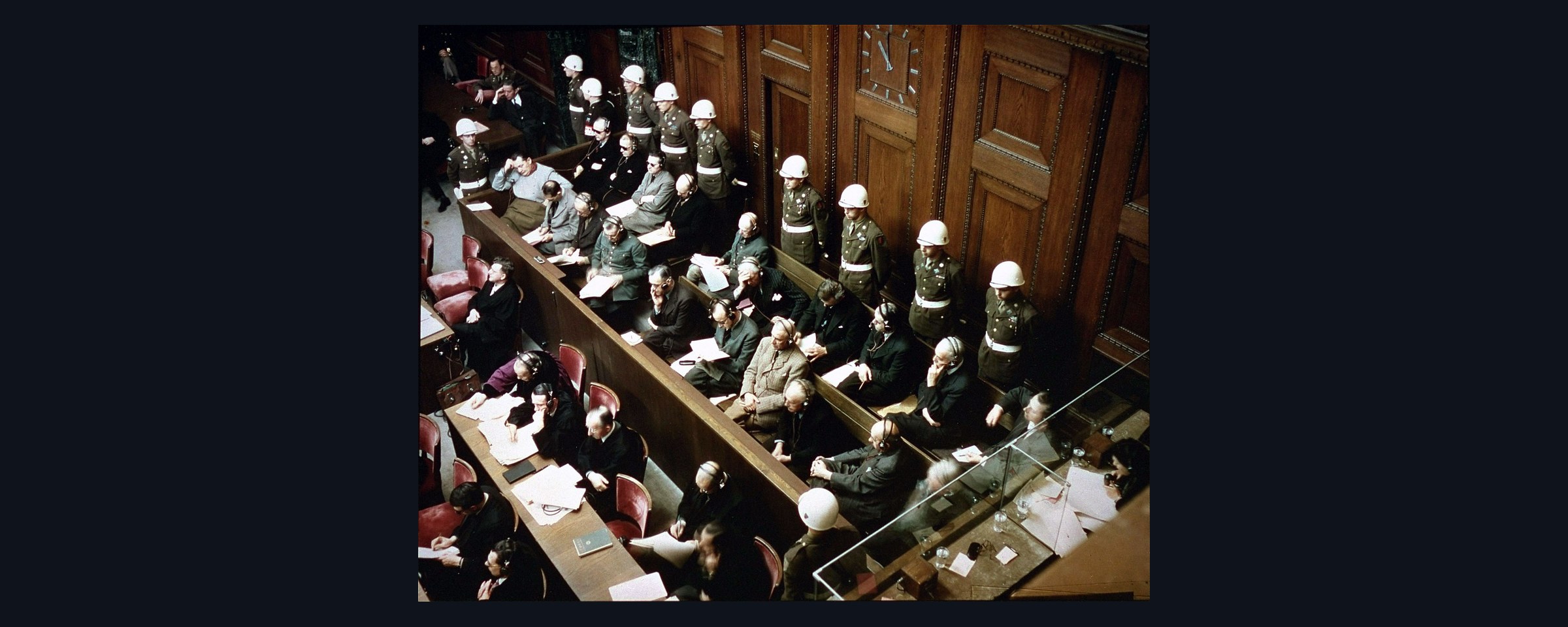
Enforcement lagged. The Leipzig trials of 1921, conducted by Germany itself under the Treaty of Versailles, produced a handful of light sentences and discredited the notion that a defeated state would try its own. The London Agreement of 8 August 1945 established the International Military Tribunal at Nuremberg, whose charter defined crimes against peace, war crimes, and crimes against humanity.2 Its judgment of 1 October 1946 convicted nineteen defendants and acquitted three. The Geneva Conventions of 1949 then set out grave breaches and universal jurisdiction over them.3 The ad hoc tribunals for the former Yugoslavia in 1993 and Rwanda in 1994 revived the practice, and the Rome Statute of 17 July 1998 created a permanent court, in force from 1 July 2002.4
The Conservative Position
Conservatives defend the substantive prohibitions with unusual firmness, because the honour of the profession of arms is a conservative concern. A military that murders prisoners degrades itself first. Discipline, hierarchy and restraint are the qualities that distinguish an army from an armed mob, and the laws of war are the written form of that distinction. This is why the sharpest objections to the destruction of civilian populations came from conservative and Catholic writers: Elizabeth Anscombe spoke against Oxford’s honorary degree for Harry Truman in Convocation on 1 May 1956, on the ground that the deliberate killing of the innocent as a means to an end is murder whatever its consequences, and published her argument as a pamphlet the following year when almost no one agreed with her.
Conservatives also insist on the separation between the justice of a war and conduct within it, the distinction between jus ad bellum and jus in bello that Michael Walzer restated for a modern audience in 1977.5 Collapsing the two produces the reasoning of the fanatic, for whom a sufficiently good cause licenses anything. The rules bind both sides because they are rules of the profession, not rewards for having the better argument.
Where conservatives divide from the international-law establishment is on institutions. Robert Taft, the leading American conservative of his generation, criticised the Nuremberg trials in a speech at Kenyon College in October 1946 — not to defend the defendants, whom he regarded as guilty, but because trying men under law written after their acts and by a court composed entirely of victors set a precedent that would be turned to other uses. John F. Kennedy included the episode in Profiles in Courage as an act of political courage.
The same reasoning grounds conservative resistance to the International Criminal Court. The United States signed the Rome Statute in December 2000 and unsigned it in May 2002; Canada ratified and enacted the Crimes Against Humanity and War Crimes Act in 2000. The conservative objection is that a prosecutor accountable to no legislature, applying elastic standards to the decisions of democratic governments at war, substitutes juridical discretion for political responsibility. The preferred alternative is domestic prosecution under national military justice — courts martial, national war crimes acts, and civilian oversight of the armed forces by an elected government that can be removed.
Differing Positions
The cosmopolitan case answers that domestic prosecution is exactly what fails. Leipzig proved that states do not reliably try their own, and the century since has offered little to contradict it. If the obligation to prosecute grave breaches is real and no national authority will discharge it, an international court is not an encroachment on sovereignty but the remedy for its abuse. The complementarity principle in the Rome Statute concedes the conservative point in part: the Court acts only where a state is unwilling or unable to proceed genuinely.
A second argument holds that the victor’s-justice objection, valid against Nuremberg’s composition, has been answered by design. The ICTY indicted Croats and Bosniaks as well as Serbs; the ICC’s jurisdiction is triggered by territory and nationality rather than by defeat. Whether the Court has lived up to that in practice is contested, and its early concentration of cases in Africa drew criticism from governments across the political spectrum.
Both sides accept the prohibitions. The disagreement is about who may enforce them and at what cost to self-government, and it is a real disagreement rather than a proxy for permissiveness.
References
- Hugo Grotius, De Jure Belli ac Pacis Libri Tres (Paris, 1625).
- Charter of the International Military Tribunal, annexed to the London Agreement of 8 August 1945.
- Geneva Convention Relative to the Protection of Civilian Persons in Time of War, 12 August 1949, articles 146-147.
- Rome Statute of the International Criminal Court, 17 July 1998, article 8.
- Michael Walzer, Just and Unjust Wars: A Moral Argument with Historical Illustrations (Basic Books, 1977).
You've read articles over the past year
Will you support conservative education?
A gift of any amount helps keep unique explanatory journalism free for all, and
supports our mission to help everyone understand the world, regardless of their
ability to pay.One-time contributors join our community of givers and will be kept
up to date on the journalism that you help keep free.

Westernization
Westernization is the adoption by non-Western societies of institutions, technologies, laws, manners and habits of mind that originated in Western Europe and its colonial offshoots....
War Crime
A war crime is a serious violation of the law of armed conflict for which an individual bears personal criminal responsibility. The category covers the...

Voter ID Laws
Voter identification laws require a person presenting to vote to prove who they are, usually by producing a government-issued document. The requirement is unremarkable across...

Voter Fraud
Voter fraud is the deliberate corruption of an election by unlawful means: impersonating another voter, casting ballots in the name of the dead or the...