
Print
Cite
Feedback
Share
Conscription is the compulsory enlistment of citizens into military service. Conservatives have argued both sides of the draft: one tradition treats it as the citizen’s debt to the nation that protects him, while the dominant strand since 1970 holds that a free society is best defended by volunteers.
The disagreement is not about patriotism but about the state. A conscript army puts the most coercive power a government possesses — command over the body of the citizen — at the centre of national life. Whether that power disciplines the state or enlarges it is the question conservatives have contested for two centuries.
Key Takeaways
- Conscription in its modern form dates from revolutionary France’s levée en masse of 1793, not from any ancient or traditional order.
- Milton Friedman and the 1970 Gates Commission made the decisive conservative case against the draft: it is a hidden tax in kind levied on young men.1
- The all-volunteer force adopted by the United States in 1973 is now the settled preference of most conservatives in the English-speaking world.
- A minority strand, stronger in continental Europe and among national conservatives, defends universal service as a school of citizenship.
History And Context
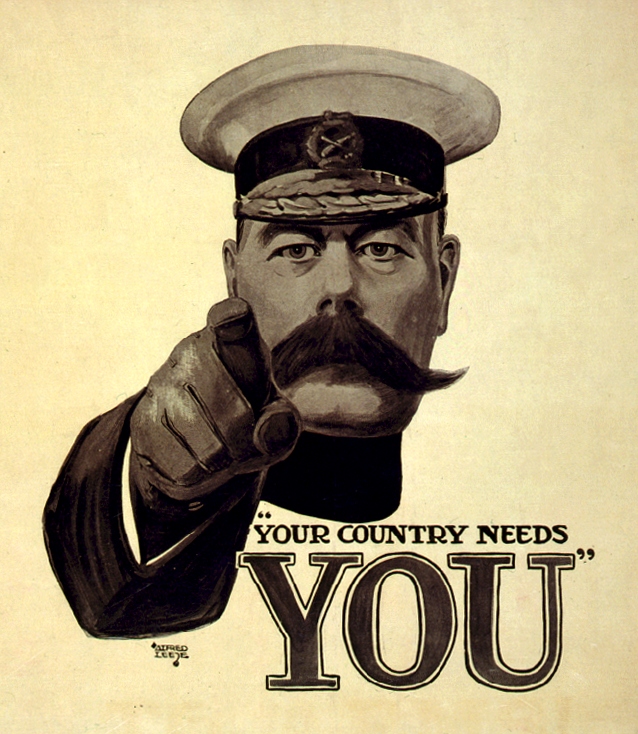
Compulsory mass military service is a child of revolution. The French National Convention decreed the levée en masse on 23 August 1793, placing the entire population in permanent requisition for the armies of the Republic. Prussia answered with its own universal service law in 1814, and by 1914 every great continental power conscripted its young men as a matter of routine.
Britain and the United States resisted longer. Britain entered the First World War with volunteers, recruited under appeals such as Alfred Leete’s 1914 Lord Kitchener Wants You poster, and only adopted compulsion with the Military Service Act of January 1916. The United States passed the Selective Service Act in 1917, let it lapse, then enacted its first peacetime draft with the Selective Training and Service Act of September 1940. Conscription continued through Korea and Vietnam, where the lottery system and student deferments bred deep resentment about who served and who escaped.
Richard Nixon campaigned in 1968 on ending the draft. He appointed the President’s Commission on an All-Volunteer Armed Force under Thomas Gates, which reported in February 1970 that a volunteer military was both feasible and just.2 The last American induction took place in June 1973. Most NATO members followed over the next four decades; France suspended conscription in 1997 and Germany in 2011.
The Conservative Position
The economic argument came first. Milton Friedman, who served on the Gates Commission, argued that the draft conceals the true cost of defence by paying conscripts below-market wages, with the difference extracted from the conscripts themselves — a tax in kind falling on a narrow class of young men rather than on the taxpaying public.1 An army of volunteers, paid honestly, forces the government to put the price of its foreign policy on the budget where citizens can see it.
The constitutional argument runs alongside. Robert Nisbet observed that mass war and mass conscription were the great engines of state centralisation in the twentieth century, dissolving the local loyalties and intermediate institutions that conservatives prize.3 A standing power to compel service is not a conservative inheritance; it is a revolutionary one, born in 1793.
Against this, a duty-centred strand persists. Thinkers in this tradition argue that rights detached from obligations corrode citizenship, and that a republic whose defence is left to a professional caste risks estranging its soldiers from its citizens. National conservatives in Israel, Finland, and increasingly in American debate cite universal service as proof that the nation is a common enterprise rather than a service provider. Most Anglosphere conservatives accept the premise about duty while rejecting the conclusion: duty freely embraced, they answer, honours the nation more than duty extracted under criminal penalty.
Differing Positions
The strongest case for conscription comes from civic egalitarians. Representative Charles Rangel, introducing a draft-restoration bill in January 2003, argued that the burden of the Iraq War would fall on working-class volunteers while the children of decision-makers stayed home; a draft, on this view, disciplines elites by exposing their own sons to the wars they vote for.4 Universal-service advocates add that shared service builds social trust across class and region in a way no market institution can. Critics of the volunteer force also note that recruitment difficulties, such as the US Army’s 25 per cent shortfall in fiscal year 2022, leave democracies strategically exposed precisely when deterrence matters most. Conservatives answer that fixing pay, standards, and purpose beats reviving compulsion, but the egalitarian objection retains force whenever volunteer numbers fail.
References
- Milton Friedman, “Why Not a Volunteer Army?”, New Individualist Review 4, no. 4 (Spring 1967).
- The Report of the President’s Commission on an All-Volunteer Armed Force (Macmillan, 1970).
- Robert Nisbet, Twilight of Authority (Oxford University Press, 1975).
- Charles B. Rangel, “Bring Back the Draft”, New York Times, 31 December 2002.
- Philosophical Conservatism: A Research Plan
- Conservatism - Wikipedia, accessed March 14, 2025, https://en.wikipedia.org/wiki/Conservatism
- Conscription - Wikipedia, accessed May 25, 2025, https://en.wikipedia.org/wiki/Conscription
- Individual liberty - Wikipedia, accessed May 25, 2025, https://en.wikipedia.org/wiki/Individual_liberty
- Limited government - Wikipedia, accessed May 25, 2025, https://en.wikipedia.org/wiki/Limited_government
- Civic duty - Wikipedia, accessed May 25, 2025, https://en.wikipedia.org/wiki/Civic_duty
- All-volunteer force - Wikipedia, accessed May 25, 2025, https://en.wikipedia.org/wiki/All-volunteer_force
- Libertarianism - Wikipedia, accessed May 25, 2025, https://en.wikipedia.org/wiki/Libertarianism
- Pacifism - Wikipedia, accessed May 25, 2025, https://en.wikipedia.org/wiki/Pacifism
You've read articles over the past year
Will you support conservative education?
A gift of any amount helps keep unique explanatory journalism free for all, and
supports our mission to help everyone understand the world, regardless of their
ability to pay.One-time contributors join our community of givers and will be kept
up to date on the journalism that you help keep free.

Westernization
Westernization is the adoption by non-Western societies of institutions, technologies, laws, manners and habits of mind that originated in Western Europe and its colonial offshoots....
War Crime
A war crime is a serious violation of the law of armed conflict for which an individual bears personal criminal responsibility. The category covers the...

Voter ID Laws
Voter identification laws require a person presenting to vote to prove who they are, usually by producing a government-issued document. The requirement is unremarkable across...

Voter Fraud
Voter fraud is the deliberate corruption of an election by unlawful means: impersonating another voter, casting ballots in the name of the dead or the...