
Print
Cite
Feedback
Share
Federalism divides sovereign authority between a national government and constituent states or provinces, each holding powers the other cannot unilaterally revoke. Conservatives have defended federalism since the American founding as the structural safeguard against concentrated power, on the reasoning that a citizen oppressed by a distant national government retains a state government, closer to home and more responsive to local majorities, capable of resisting or moderating that oppression.
The American framers built federalism directly into the Constitution’s design after the Articles of Confederation had proven too weak to govern and a fully consolidated national government had appeared to many delegates as too dangerous to liberty. James Madison defended the resulting compromise in Federalist No. 51, arguing that dividing power between federal and state governments, and further subdividing federal power among three branches, gave “a double security” to the rights of the people, since each level of government would check the ambitions of the other.1
Key Takeaways
- Federalism reserves undelegated powers to the states or to the people under the Tenth Amendment, a provision conservatives cite as the textual basis for limiting federal authority to its enumerated list.
- Conservative jurisprudence has revived federalism as an active constitutional doctrine since the 1990s, notably in United States v. Lopez (1995), the first Supreme Court decision in six decades to strike down a federal law as exceeding the Commerce Clause.
- Federalism allows policy experimentation across states, a benefit Justice Louis Brandeis famously described as treating states as “laboratories” that can test approaches without imposing the risk of failure on the entire nation.
- Conservatives distinguish federalism from mere administrative decentralization: federalism requires that state authority be constitutionally protected, not simply delegated at the discretion of the national government.
- Federal grants-in-aid, which now fund large portions of state budgets, have complicated federalism in practice by giving Washington leverage over policy areas the Constitution does not directly assign it, through conditions attached to funding rather than direct command.
History And Context
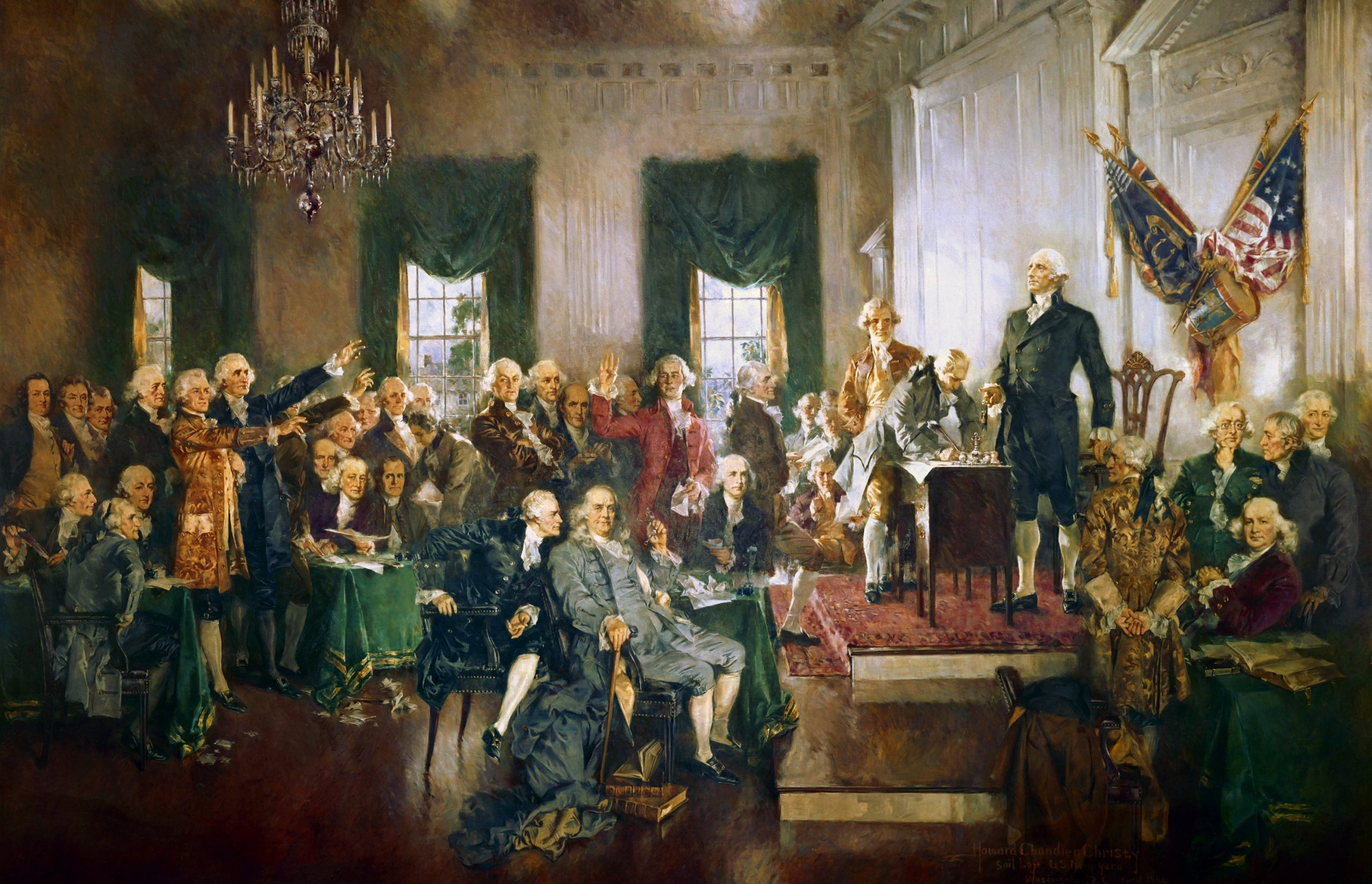
The Constitutional Convention of 1787 confronted a design problem: a confederation of sovereign states, as attempted under the Articles of Confederation from 1781 to 1789, lacked the power to tax, regulate interstate commerce, or enforce its own laws, leaving the young nation unable to pay its Revolutionary War debts or respond to armed unrest such as Shays’ Rebellion in Massachusetts in 1786 and 1787.2 The delegates rejected both the weak confederation model and a fully consolidated unitary government, instead creating a novel arrangement in which the national government would hold specifically enumerated powers, primarily over foreign affairs, interstate and international commerce, and national defense, while the states retained general police power over most matters touching daily life.
The system’s balance shifted substantially during the twentieth century. The New Deal-era Supreme Court, after 1937, upheld an increasingly expansive reading of the Commerce Clause that allowed Congress to regulate activities with only indirect effects on interstate commerce, and the postwar growth of federal grant programs tied to conditions gave Washington practical influence over education, highway construction, and welfare policy that the framers had assigned to the states. This expansion continued largely unchecked by judicial review until the Rehnquist Court’s federalism revival beginning with Lopez in 1995, which held that Congress had exceeded its Commerce Clause authority in banning gun possession near schools, a decision conservative legal scholars had sought for decades.3
The Conservative Position
Conservatives defend federalism on both structural and practical grounds. Structurally, dividing sovereignty prevents any single government from accumulating the total power the framers associated with tyranny; Madison’s “double security” argument in Federalist No. 51 remains the touchstone citation in conservative constitutional argument on this point. Practically, conservatives argue that federalism permits policy to match the genuine diversity of a large, heterogeneous country. States can set their own minimum wages, occupational licensing rules, and social policies according to local preference and local economic conditions, avoiding the one-size-fits-all friction that a single national standard imposes on regions with different costs of living and different political cultures.
Conservative legal scholars associated with the Federalist Society, founded in 1982, have pushed for judicial enforcement of federalism limits on Congress specifically because they view unenforced constitutional text as an invitation to unlimited federal growth. Justice Antonin Scalia and Justice Clarence Thomas both wrote opinions arguing that the Commerce Clause and the Necessary and Proper Clause had been stretched by decades of precedent well beyond what their text supports, and conservative litigation strategy since the 1990s has repeatedly sought cases that would let the Court draw a clearer, judicially enforceable boundary around federal power.4
Differing Positions
Progressive legal scholars and many economists respond that federalism’s practical effect has often been to let states with regressive preferences resist national protections, pointing to the century in which southern states used federalism and states’ rights arguments to preserve segregation against federal civil rights enforcement, most visibly during the mid-twentieth century civil rights movement. On this view, a national government answerable to national majorities and courts is better positioned to protect minority rights than fifty separate governments, some of which may be captured by local majorities hostile to those rights. Critics also argue that federalism produces a genuine race to the bottom in areas like environmental regulation and corporate taxation, where states compete to attract business by weakening standards, a dynamic that only national uniform regulation can prevent, since no individual state can afford to hold a higher standard unilaterally without losing investment to its neighbors.
References
- James Madison, “Federalist No. 51,” in The Federalist Papers, ed. Clinton Rossiter (New American Library, 1961), p. 323.
- Forrest McDonald, Novus Ordo Seclorum: The Intellectual Origins of the Constitution (University Press of Kansas, 1985), p. 162.
- United States v. Lopez, 514 U.S. 549 (1995).
- Randy E. Barnett, Restoring the Lost Constitution: The Presumption of Liberty (Princeton University Press, 2004), p. 279.
- Willik, Jason. 2023. " The conservative challenge to liberalism goes deeper than self-interest." The Washington Post. February 12. https://www.washingtonpost.com/opinions/2023/02/12/conservative-values-free-speech-federalism/.
You've read articles over the past year
Will you support conservative education?
A gift of any amount helps keep unique explanatory journalism free for all, and
supports our mission to help everyone understand the world, regardless of their
ability to pay.One-time contributors join our community of givers and will be kept
up to date on the journalism that you help keep free.

Westernization
Westernization is the adoption by non-Western societies of institutions, technologies, laws, manners and habits of mind that originated in Western Europe and its colonial offshoots....
War Crime
A war crime is a serious violation of the law of armed conflict for which an individual bears personal criminal responsibility. The category covers the...

Voter ID Laws
Voter identification laws require a person presenting to vote to prove who they are, usually by producing a government-issued document. The requirement is unremarkable across...

Voter Fraud
Voter fraud is the deliberate corruption of an election by unlawful means: impersonating another voter, casting ballots in the name of the dead or the...