
Print
Cite
Feedback
Share
Maoism is the body of doctrine Mao Zedong built out of Marxism-Leninism between the late 1920s and his death in 1976: peasant rather than proletarian revolution, protracted armed struggle from rural base areas, the mass line, and permanent revolution against the residue of the old society inside the new one. It governed China from 1949 to 1976 and supplied the template for insurgencies from Peru to Nepal.
Conservatives regard it as the century’s clearest demonstration of what happens when a movement treats inherited society as raw material. The Great Leap Forward produced the largest famine in recorded history, with credible estimates ranging from fifteen million to forty-five million deaths between 1958 and 1962.1 The Cultural Revolution then set out to destroy the Four Olds — old customs, culture, habits and ideas — by wrecking temples, burning libraries, smashing ancestral graves and setting students against teachers. This was not an accident of implementation. It was the programme.
Key Takeaways
- Maoism relocated the revolutionary subject from the industrial worker to the peasantry and made protracted rural war the route to power.
- The People’s Republic was founded on 1 October 1949; Mao died on 9 September 1976 and Deng Xiaoping began dismantling the economic model from 1978.
- The Great Leap Forward, launched in 1958, caused mass famine; Frank Dikötter puts the toll at a minimum of forty-five million.1
- The Cultural Revolution, launched in 1966, targeted teachers, clergy, family authority and inherited culture as such.
- Western intellectual enthusiasm for Maoism during the 1960s and 1970s is treated by conservatives as evidence about the intelligentsia rather than about China.45
History And Context
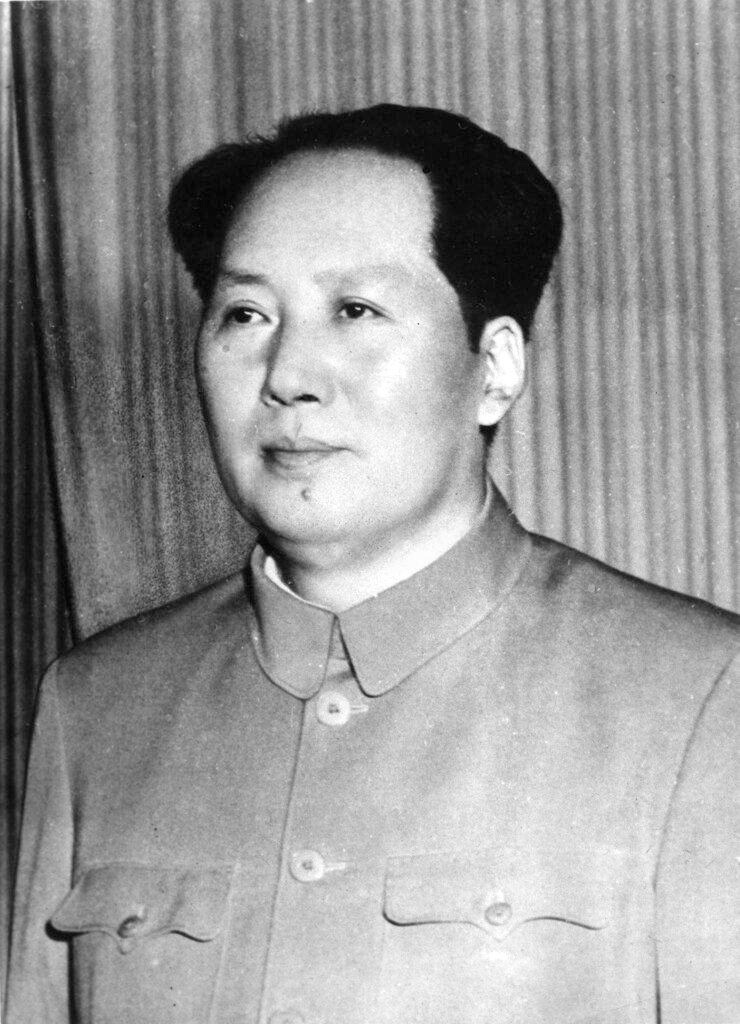
Mao’s departure from Soviet orthodoxy began in 1927. His Report on an Investigation of the Peasant Movement in Hunan argued that the rural poor, not the small urban working class, were the engine of Chinese revolution — a heresy in Comintern terms. After the Long March of 1934 and 1935 the Communists established themselves at Yan’an, where Mao developed the doctrines of protracted war, the mass line and rectification, and where the first purge campaigns rehearsed what would come later.
The People’s Republic was proclaimed on 1 October 1949. Land reform between 1950 and 1953 redistributed holdings and killed somewhere between one and two million landlords in the process. Collectivisation followed, then the Hundred Flowers Campaign of 1956 and 1957, which invited criticism and then used the responses to identify targets for the Anti-Rightist Campaign that punished several hundred thousand people.
The Great Leap Forward began in 1958. Communes were amalgamated, backyard furnaces built, grain requisitioned against inflated harvest reports, and peasants forbidden to leave. Local cadres competed to report yields they had not produced, and the state exported grain while villages starved. Dikötter’s work in provincial archives documents systematic violence alongside the starvation.1 The Sino-Soviet split hardened in the same years, and Mao’s loss of authority after the famine drove the next convulsion.
In 1966 Mao launched the Cultural Revolution against his own party. Red Guards humiliated and beat teachers, doctors and officials; universities closed for years; an estimated seventeen million urban youths were sent to the countryside. The campaign wound down only with Mao’s death in 1976 and the arrest of the Gang of Four weeks later. In 1981 the Party’s own resolution described the Cultural Revolution as responsible for the gravest setback since 1949.
The Conservative Position
The conservative objection is not primarily economic. It is that Maoism identified inheritance itself as the enemy. Michael Oakeshott distinguished politics conducted as the pursuit of an intimation within an existing tradition from politics conducted as the imposition of a rationally designed end.2 Maoism is the second in its purest form: a project to reconstruct the family, the village, the language and the calendar from a blueprint, executed against the resistance of everything already there.
Ancestor veneration, clan lineage, Confucian schooling, Buddhist and Daoist temples, footbinding and arranged marriage, guilds and secret societies — Maoism attacked the defensible and the indefensible with equal force, because the criterion was age rather than merit. Burke’s argument was that inherited practice carries knowledge no designer possesses, and that the reformer who cannot say what a custom is for should hesitate before abolishing it. The backyard furnace campaign is the fable version: peasants melted their own cooking pots to make pig iron too brittle to use, and then had nothing to cook in.
Conservatives also press the point about elite opinion abroad. During the Cultural Revolution, when the facts were substantially available, Maoism attracted admirers in Western universities, publishing houses and film. Roger Scruton catalogued the pattern of Western thinkers who excused or romanticised regimes whose victims they never had to meet.4 Thomas Sowell made the structural argument: intellectuals face no cost for being wrong about distant catastrophes, which weakens the feedback that disciplines every other profession.5 Julia Lovell’s global history shows how effectively the doctrine travelled as an export product, from the Shining Path in Peru to the Naxalites in India.3
Differing Positions
Defenders of the Mao period argue that the ledger is not only famine. Life expectancy in China rose substantially between 1949 and 1976 — most estimates put it in the mid-thirties at the founding and above sixty by the mid-1970s — through basic public health, vaccination campaigns, and rural clinics staffed by barefoot doctors. Literacy and primary enrolment expanded from a very low base. Amartya Sen and Jean Drèze argued that pre-reform China’s investment in basic health and education explained its advantage over India on those measures, even while insisting that the absence of a free press was what allowed the famine to run for four years unchecked.6
A second line holds that the achievements of the reform era rested on Maoist foundations: land reform destroyed the gentry, mass schooling created a literate workforce, and the state built irrigation and rail capacity that Deng’s reforms then used. A third dispute is about numbers rather than judgement. Dikötter’s forty-five million figure sits at the high end; demographers working from census reconstruction, including Judith Banister, produced estimates closer to thirty million, and the difference concerns method — excess mortality against reconstructed birth deficits — rather than whether the famine was man-made.
References
- Frank Dikötter, Mao’s Great Famine: The History of China’s Most Devastating Catastrophe, 1958–1962 (Bloomsbury, 2010).
- Michael Oakeshott, Rationalism in Politics and Other Essays (Methuen, 1962).
- Julia Lovell, Maoism: A Global History (Bodley Head, 2019).
- Roger Scruton, Fools, Frauds and Firebrands: Thinkers of the New Left (Bloomsbury Continuum, 2015).
- Thomas Sowell, Intellectuals and Society (Basic Books, 2010).
- Jean Drèze and Amartya Sen, Hunger and Public Action (Clarendon Press, 1989).
You've read articles over the past year
Will you support conservative education?
A gift of any amount helps keep unique explanatory journalism free for all, and
supports our mission to help everyone understand the world, regardless of their
ability to pay.One-time contributors join our community of givers and will be kept
up to date on the journalism that you help keep free.
Westernization
Westernization is the adoption by non-Western societies of institutions, technologies, laws, manners and habits of mind that originated in Western Europe and its colonial offshoots....
War Crime
A war crime is a serious violation of the law of armed conflict for which an individual bears personal criminal responsibility. The category covers the...

Voter ID Laws
Voter identification laws require a person presenting to vote to prove who they are, usually by producing a government-issued document. The requirement is unremarkable across...

Voter Fraud
Voter fraud is the deliberate corruption of an election by unlawful means: impersonating another voter, casting ballots in the name of the dead or the...