
Print
Cite
Feedback
Share
Key Takeaways
- Marxism is a socio-political and economic ideology rooted in the critique of capitalism.
- Conservatism is completely counter to Marxism.
- Conservatives raise concerns about Marxism’s impact on individual liberty, the economy, and governmental overreach.
Introduction
Marxism, an ideology by Karl Marx and Friedrich Engels in the 19th century, examines class struggle and critiques capitalism. It aims to grasp and transform societal contradictions and inequalities within capitalist systems.
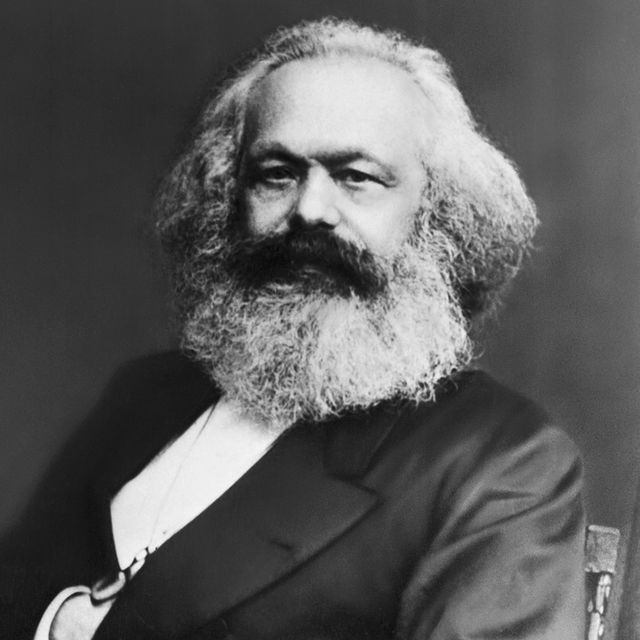
At its core, Marxism asserts that society is divided into two primary classes: the bourgeoisie, who own and control the means of production, and the proletariat, the working class who sell their labor for wages. Marxists argue that capitalism inherently maintains exploitation and constant class conflict, because the bourgeoisie extract surplus and unfair value from the labor of the proletariat.[1]
Marxism’s ultimate goal is to achieve a classless society through a process of revolution where resources are collectively owned and distributed to each individual according to their needs, independent of their work or efforts. Over the years, Marxism has evolved and branched into various interpretations and adaptations, giving rise to different schools of thought such as Leninism, Trotskyism, and Maoism.
Conservative view
The conservative critique of Marxism can be summarized by four main points. First, Marxism necessarily infringes on human liberties. Second, Marxism creates a system that does not reward hard work or talent. Third, Marxism creates clashes between classes. Fourth, there is overwhelming historic evidence of Marxism failing as a system and resulting in mass death.
Individual liberty and ownership rights
Conservatives argue that Marxism’s focus on collective ownership infringes on individual liberties. Conservatives believe that individuals should have the freedom to own private property and make economic decisions without government interference, because such freedom encourages individual initiative and personal responsibility.
Moreover, conservatives claim that Marxism, by abolishing private property and wealth accumulation, stifles individual incentive and entrepreneurship. The prospect of personal gain and success drives individuals to work harder, create businesses, and innovate, which may be undermined in a Marxist system.[2]
Government bureaucracy and economic concerns
Conservatives express concerns about the growth of a large and powerful government bureaucracy in Marxist systems. Conservatives argue that centralized control can lead to inefficiency, corruption, and a lack of responsiveness to the needs of individuals and local communities. History has shown repeatedly that centrally planned economies are simply not as efficient as free market economies. North Korea, the USSR, and East Germany are examples of highly inefficient, centrally planned economies.
Class divisions
Conservatives hold that Marxist class analysis fosters division and resentment between social classes, arguing that emphasizing class struggle can hinder social cohesion and unity, potentially leading to class-based conflicts. Marx explicitly speaks of how there are different classes that are at odds with each other, and that one class is abusing the other. Conservatives also contend that Marxism’s focus on distributing wealth according to need can discourage hard work and productivity since individuals may perceive less benefit from their efforts when everyone receives the same regardless of their contribution.[3]
Historical evidence
Conservatives often point to the historical failures of Marxist regimes, such as the Soviet Union and Maoist China, arguing that it resulted in authoritarianism, economic hardship, human rights abuses, and the death of many millions (be it from starvation or political persecution as a result of communist governments).
- [1] Barker, Colin, Laurence Cox, John Krinsky, and Alf Gunvald Nilsen. 2013. “Marxism and Social Movements: An Introduction.” BRILL EBooks, January, 1–37. doi:https://doi.org/10.1163/9789004251434_002.
- [2] Chitty, Andrew. 2009. “Marx and Conservatism.” January. doi:https://doi.org/10.1057/9780230242227_6.
- [3] Chait, Jonathan. 2016. “Oh, Good, It’s 2016 and We’re Arguing about Whether Marxism Works.” Intelligencer. March 30. https://nymag.com/intelligencer/2016/03/oh-good-were-arguing-whether-marxism-works.html.
You've read articles over the past year
Will you support conservative education?
A gift of any amount helps keep unique explanatory journalism free for all, and
supports our mission to help everyone understand the world, regardless of their
ability to pay.One-time contributors join our community of givers and will be kept
up to date on the journalism that you help keep free.

Westernization
Westernization is the adoption by non-Western societies of institutions, technologies, laws, manners and habits of mind that originated in Western Europe and its colonial offshoots....
War Crime
A war crime is a serious violation of the law of armed conflict for which an individual bears personal criminal responsibility. The category covers the...

Voter ID Laws
Voter identification laws require a person presenting to vote to prove who they are, usually by producing a government-issued document. The requirement is unremarkable across...

Voter Fraud
Voter fraud is the deliberate corruption of an election by unlawful means: impersonating another voter, casting ballots in the name of the dead or the...