
Print
Cite
Feedback
Share
Milton Friedman (1912–2006) was the most consequential economist of the American right in the twentieth century. He rebuilt the case for free markets at a moment when Keynesian management was the settled consensus, showed that inflation is a monetary phenomenon rather than a wage-price accident, and argued that economic freedom and political freedom stand or fall together. His work moved from technical journals to the living rooms of ordinary voters, and the policies that followed — the end of conscription, floating exchange rates, inflation targeting, school choice — carry his fingerprints.
Conservatives claim Friedman as a founder, though he called himself a classical liberal. What the tradition took from him was not a doctrine of greed but an argument about knowledge and power: that dispersed decisions coordinated by prices handle information no central authority can gather, and that concentrating economic decisions in the state concentrates political power with them.
Key Takeaways
- Friedman established that sustained inflation is caused by monetary expansion outrunning output, not by unions, oil producers or corporate greed.
- With Anna Schwartz he showed the Federal Reserve turned the 1929 downturn into the Great Depression by allowing the money stock to contract by a third.
- His natural rate hypothesis, advanced in 1967, predicted the stagflation of the 1970s and broke the policy consensus that unemployment could be bought down permanently with inflation.
- Capitalism and Freedom (1962) and Free to Choose (1980) carried the argument to a mass audience and supplied the intellectual scaffolding for the Thatcher and Reagan governments.
- His practical proposals — school vouchers, the negative income tax, an all-volunteer military — reshaped policy debate well beyond economics.
History And Context
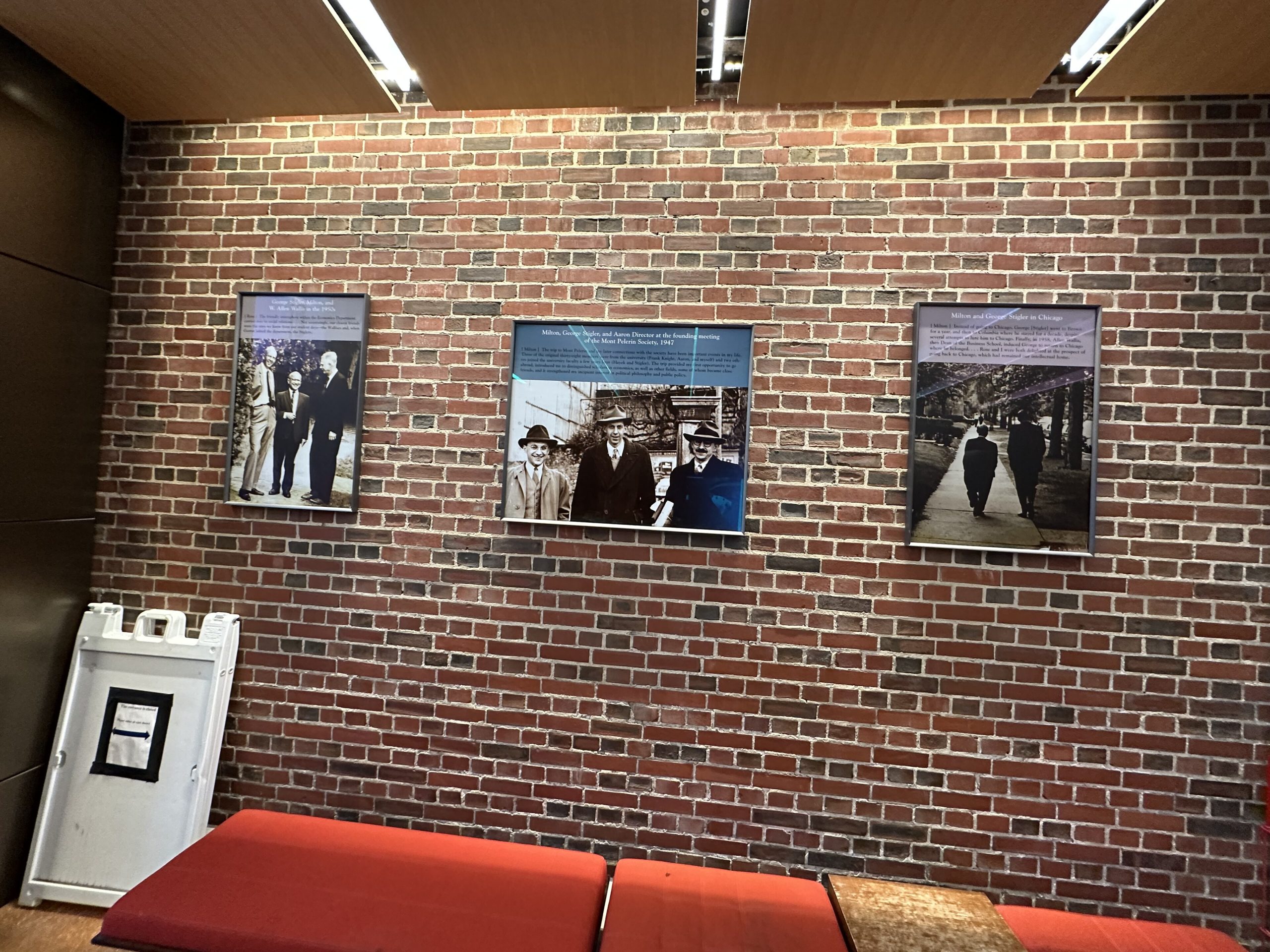
Friedman was born in Brooklyn on 31 July 1912 to Jewish immigrants from Beregszász in Hungary. He took his undergraduate degree at Rutgers in 1932, a master’s at Chicago in 1933, and his doctorate at Columbia in 1946. During the Second World War he worked at the Treasury’s Division of Tax Research, where he helped design payroll withholding — a contribution he later regretted for the ease with which it let government collect revenue unnoticed.
He joined the University of Chicago faculty in 1946 and stayed for three decades, forming with George Stigler, Aaron Director and later Gary Becker the school of thought that took the university’s name. The Chicago approach combined price theory applied without exception to real problems, empirical testing against data, and scepticism toward the claim that government intervention improves on market outcomes.
The technical work came first. A Theory of the Consumption Function (1957) undercut the Keynesian multiplier by showing households spend according to permanent rather than current income. A Monetary History of the United States, 1867–1960, written with Anna Schwartz and published in 1963, traced the money supply across a century and located the cause of the Great Depression in Federal Reserve failure between 1929 and 1933.2 In his presidential address to the American Economic Association in December 1967, Friedman argued that there is no permanent trade-off between inflation and unemployment: attempts to hold unemployment below its natural rate produce accelerating inflation and nothing else.3 Edmund Phelps reached the same conclusion independently. The 1970s confirmed both.
Capitalism and Freedom appeared in 1962 and sold in the hundreds of thousands.1 Friedman served on the Gates Commission in 1969–70, whose report led to the end of the draft in 1973. He received the Nobel Memorial Prize in Economic Sciences in 1976, moved to the Hoover Institution at Stanford in 1977, and in 1980 published Free to Choose with his wife and collaborator Rose Director Friedman alongside a ten-part PBS series that reached millions.4 He died in San Francisco on 16 November 2006.
The Conservative Position
Friedman’s central claim is about knowledge. No planner can assemble the information held by millions of buyers and sellers, because that information exists only as it is acted on. Prices carry it, and they do so without anyone needing to understand the whole. This is why he opposed wage and price controls, rent control and industrial policy: each destroys the signal that makes coordination possible, and then blames the resulting shortage on the market.
The second claim is about power. Economic freedom is not merely a component of freedom but a check on political authority. A society in which the state directs employment, credit and enterprise leaves dissenters with no independent means of support, and a critic who cannot earn a living outside official channels is not free to criticise. Friedman pressed this point against the argument that political liberty can be preserved while economic life is centrally directed.
The third is about incentives inside government. Friedman held that programmes should be judged by results rather than intentions, and that agencies acquire interests of their own. Hence his preference for rules over discretion in monetary policy, for cash transfers over administered services, and for vouchers that put purchasing power with parents rather than with school boards. He first proposed education vouchers in 1955 and argued the case for the next fifty years.
Differing Positions
The serious critique of Friedman comes in three parts. The first is empirical: the stable relationship between money and prices that underwrote monetarism broke down after financial deregulation in the 1980s, as innovation blurred the definition of money. Central banks that adopted monetary targets abandoned them within a decade, and the Bank of Canada, the Bank of England and the Federal Reserve moved to inflation targets and interest rate rules instead.
The second is about the Depression. Keynesian and post-Keynesian economists accept that Federal Reserve failure worsened the contraction while arguing that collapsing demand, debt deflation and the gold standard’s constraints carried more weight than the money stock alone. The debate remains live among economic historians.
The third is normative. Critics argue that Friedman’s framing treats market outcomes as the baseline and every intervention as a deviation requiring justification, which loads the analysis before it starts. On this account his 1970 argument that a corporation’s responsibility is to increase profits within the rules ignores how firms write the rules. Friedman’s answer was that the alternative — managers spending shareholders’ money on objectives they select themselves — substitutes an unelected private authority for a market test without solving the problem.
References
- Milton Friedman, Capitalism and Freedom (University of Chicago Press, 1962), ch. 1.
- Milton Friedman and Anna J. Schwartz, A Monetary History of the United States, 1867–1960 (Princeton University Press, 1963), ch. 7.
- Milton Friedman, “The Role of Monetary Policy,” American Economic Review 58, no. 1 (March 1968).
- Milton Friedman and Rose D. Friedman, Free to Choose: A Personal Statement (Harcourt Brace Jovanovich, 1980), ch. 6.
You've read articles over the past year
Will you support conservative education?
A gift of any amount helps keep unique explanatory journalism free for all, and
supports our mission to help everyone understand the world, regardless of their
ability to pay.One-time contributors join our community of givers and will be kept
up to date on the journalism that you help keep free.

Milton Friedman
Milton Friedman (1912–2006) was the most consequential economist of the American right in the twentieth century. He rebuilt the case for free markets at a...

Margaret Thatcher
Margaret Thatcher was Prime Minister of the United Kingdom from 4 May 1979 to 28 November 1990, the longest continuous premiership of the twentieth century...

Karl Marx
Karl Marx (1818–1883) was the German philosopher and economist whose theory of class struggle became the most consequential political doctrine of the modern age. With...

Thomas Aquinas
Thomas Aquinas was a thirteenth-century Italian Dominican friar, theologian, and philosopher whose synthesis of Aristotelian philosophy and Christian doctrine became the most influential intellectual framework...