
Print
Cite
Feedback
Share
Moral skepticism is the family of positions holding that moral knowledge is unavailable, that moral claims lack truth value, or that no moral judgement is objectively better founded than its opposite. It runs from the Greek sophists through Hume’s separation of fact from value to the error theory and emotivism of the twentieth century. Conservatives have treated it as the central intellectual problem of the modern age, because a society that cannot say why an act is wrong loses the capacity to sustain the habits on which its order depends.
The conservative response is not a counter-proof. It is a different account of how moral knowledge is held. Burke’s answer to the rationalist demand that every moral rule justify itself at the bar of individual reason was that the wisdom carried in inherited practice exceeds what any one mind can reconstruct, and that the demand itself is the error. Moral knowledge exists in the way a language exists: fluently used, imperfectly articulated, and destroyed by the attempt to rebuild it from first principles.
Key Takeaways
- Moral skepticism comes in distinct forms — epistemological, error-theoretic and non-cognitivist — that require separate answers.
- Hume’s is-ought passage of 1740 set the modern problem: no argument moves validly from statements of fact to statements of obligation.
- Conservatives locate moral knowledge in practice, custom and prescription rather than in deductive proof.
- MacIntyre’s After Virtue diagnosed modern moral argument as interminable because the fragments of an older teleological framework survive without the framework.
- The practical conservative objection is that skepticism does not produce neutrality; it transfers moral authority from tradition to whoever holds power.
History And Context
The Greek sophists opened the question. Protagoras held that man is the measure of all things, which his critics read as making moral truth relative to the perceiver. Plato’s dialogues are largely an attempt to answer him. Pyrrho of Elis, in the fourth century BC, extended suspension of judgement to all claims, and the tradition was preserved and systematised by Sextus Empiricus in the Outlines of Pyrrhonism around AD 200 — the text through which ancient scepticism reached the Renaissance.
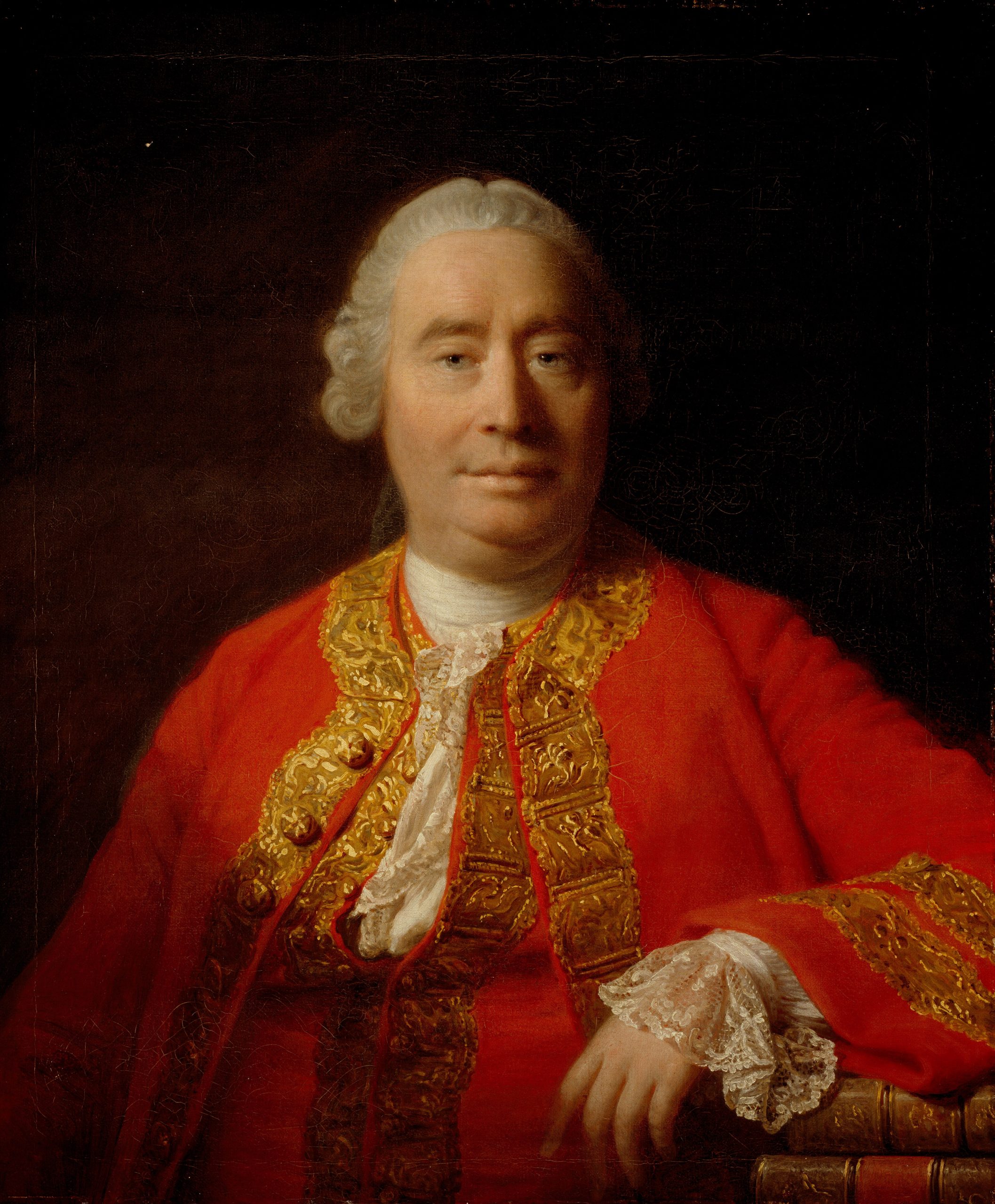
David Hume gave the argument its modern form in the third book of the Treatise, published in 1740. Writers on morality, he observed, proceed by ordinary reasoning about what is, then substitute without warning propositions about what ought to be, and the transition is never explained.1 Hume was not himself a moral nihilist — he grounded morals in sentiment and in the artificial virtues that convention builds — but the gap he identified has structured every subsequent debate.
The twentieth century produced two sharp versions. A. J. Ayer’s Language, Truth and Logic of 1936 argued that moral statements express attitudes rather than assert facts, and so are neither true nor false. J. L. Mackie’s Ethics: Inventing Right and Wrong of 1977 accepted that moral statements make objective claims and held that all of them are false, since objective values would be entities unlike anything else in the universe.2
Alasdair MacIntyre answered in 1981. After Virtue argued that modern moral disagreement is interminable because the competing positions are surviving fragments of older traditions, stripped of the teleological account of human nature that gave them sense; emotivism is the accurate description of what moral discourse has become rather than of what it must be.3
The Conservative Position
Conservatives accept a great deal of the skeptical case against rationalist ethics while rejecting its conclusion. Burke’s Reflections of 1790 attacked the attempt to derive a political and moral order from abstract principle, and defended prejudice — settled disposition formed by long practice — as knowledge in a form that can be acted on without being fully articulated.4 The person who acts rightly under pressure does so from formed character, not from a completed derivation.
This yields three positions. First, moral knowledge is real but is transmitted through institutions: family, church, craft, regiment, common law. The test of a moral tradition is its capacity to produce people who act well over generations, which is an empirical test rather than an appeal to authority.
Second, the demand for foundations is itself corrosive. Michael Oakeshott’s distinction between technical and practical knowledge applies directly: the attempt to reduce a moral practice to a set of statable rules discards the part that does the work, and then the reduced version fails and is taken as evidence that the practice was empty.
Third, skepticism does not leave a vacuum. Where inherited moral authority is dissolved, the space is occupied by whatever agency is strong enough to fill it — the state, the market, or the fashion of the moment. Russell Kirk’s first principle was that a durable order rests on belief in an enduring moral order, and his argument was practical: societies that stop believing their moral rules are true stop obeying them under strain.
Differing Positions
The skeptic’s case does not depend on wanting the conclusion. Mackie’s argument from queerness holds that objective prescriptive facts would have to be entities of a kind found nowhere else — capable on their own of motivating anyone who perceives them — and that the burden falls on those asserting them. His argument from relativity adds that the range of moral codes across societies is explained better by variation in ways of life than by uneven access to moral truth.
A second line grants the conservative point about tradition and turns it around. Traditions have carried slavery, caste and the subjection of women, and were defended in each case by appeal to accumulated practice. If the test of a tradition is its fruits, some traditions fail it, and the criterion used to judge them cannot itself be internal to them.
A third position holds that skepticism about ultimate ends is the ground of toleration. A state that cannot know which conception of the good is correct has reason to protect several, and the liberal settlement follows from that modesty rather than from indifference.
Conservatives reply that reform of a tradition has always proceeded from inside it — abolition was argued in the language of Christian moral realism, not of skepticism — and that a doctrine holding all moral claims false supplies no ground for tolerating anything.
References
- David Hume, A Treatise of Human Nature, bks. 1–2 (London: John Noon, 1739); bk. 3 (London: Thomas Longman, 1740), bk. 3, pt. 1, sec. 1.
- J. L. Mackie, Ethics: Inventing Right and Wrong (Penguin, 1977), ch. 1.
- Alasdair MacIntyre, After Virtue (University of Notre Dame Press, 1981), ch. 2.
- Edmund Burke, Reflections on the Revolution in France (London: J. Dodsley, 1790).
You've read articles over the past year
Will you support conservative education?
A gift of any amount helps keep unique explanatory journalism free for all, and
supports our mission to help everyone understand the world, regardless of their
ability to pay.One-time contributors join our community of givers and will be kept
up to date on the journalism that you help keep free.
Westernization
Westernization is the adoption by non-Western societies of institutions, technologies, laws, manners and habits of mind that originated in Western Europe and its colonial offshoots....
War Crime
A war crime is a serious violation of the law of armed conflict for which an individual bears personal criminal responsibility. The category covers the...
Voter ID Laws
Voter identification laws require a person presenting to vote to prove who they are, usually by producing a government-issued document. The requirement is unremarkable across...

Voter Fraud
Voter fraud is the deliberate corruption of an election by unlawful means: impersonating another voter, casting ballots in the name of the dead or the...