
Print
Cite
Feedback
Share
Nazism was the ideology of the National Socialist German Workers’ Party, which governed Germany from Adolf Hitler’s appointment as chancellor on 30 January 1933 until the surrender of 8 May 1945. It combined biological racism, a cult of the leader, hostility to parliamentary government, state direction of the economy, and the pursuit of territorial conquest in eastern Europe. Its central project was the extermination of European Jewry, in which roughly six million people were murdered.
Conservatives treat Nazism as a revolutionary movement of the twentieth-century left-right hybrid variety, not as an extreme form of conservatism. The distinction rests on what the regime did: it subordinated the churches, the aristocracy, the officer corps, the guilds, the universities, and the family to a single party, and it justified this by an appeal to racial destiny that no traditional conservative doctrine contains. A creed that abolished every inherited institution in Germany within six years was not conserving anything.
Key Takeaways
- The Nazi Party governed Germany from 30 January 1933 to 8 May 1945.
- Its ideology fused racial biology, leader-worship, economic direction, and territorial expansion.
- The Enabling Act of 23 March 1933 gave Hitler’s cabinet legislative power and ended the Weimar constitution in practice.
- Conservatives classify Nazism as a revolutionary and totalitarian movement rather than a conservative one, on the evidence of what it destroyed.
- German conservatives who thought they could contain Hitler in a coalition were removed, imprisoned, or shot within eighteen months.
History And Context
The party grew out of the German Workers’ Party founded in Munich in January 1919. Hitler joined that September, renamed it in 1920, and attempted a coup in Munich on 8 November 1923 that collapsed the next morning. He served nine months in Landsberg prison, where he dictated the first volume of Mein Kampf, published in July 1925.
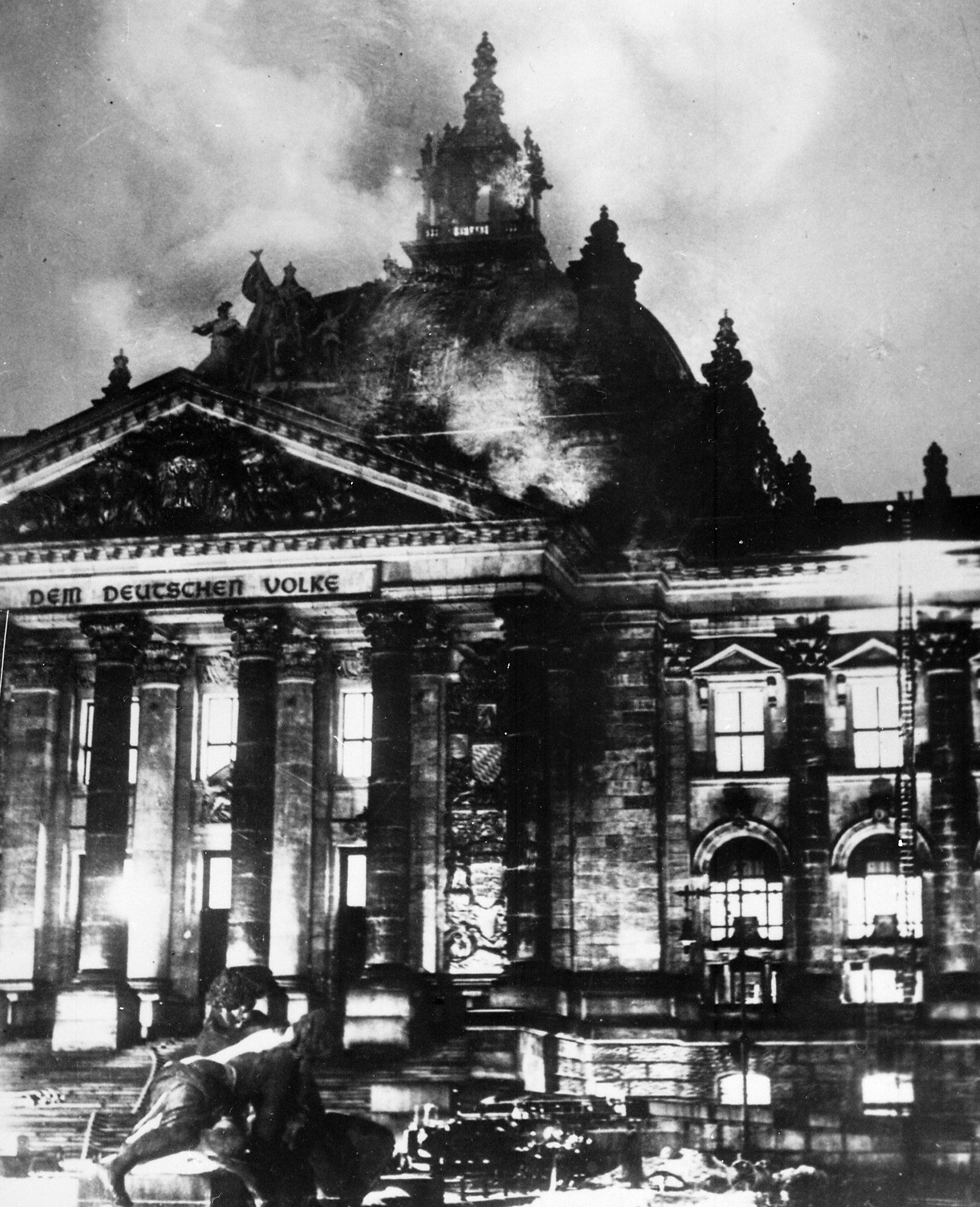
Electoral breakthrough came with economic collapse. The party held twelve Reichstag seats in 1928 and 107 after the September 1930 election, then 230 in July 1932. Franz von Papen and a circle of conservative politicians persuaded President Hindenburg to appoint Hitler chancellor on 30 January 1933 on the theory that they could control him inside a cabinet where Nazis held only three of eleven posts. The Reichstag fire on 27 February 1933 produced an emergency decree suspending civil liberties the following day. The Enabling Act of 23 March 1933 transferred legislative power to the cabinet. Trade unions were dissolved in May, the other parties by July.
Then the regime turned on its conservative allies. The purge of 30 June 1934, known as the Night of the Long Knives, killed the SA leadership along with the former chancellor Kurt von Schleicher and members of von Papen’s staff. Ian Kershaw’s biography traces how quickly the coalition theory collapsed.1 Michael Burleigh’s history documents the regime’s treatment of the Catholic and Protestant churches, which it harassed, infiltrated, and in the case of dissenting clergy imprisoned.2 Richard Overy’s comparative study of Hitler’s Germany and Stalin’s Russia sets out the structural resemblance between the two systems.3
The Conservative Position
Conservative analysis of Nazism makes three claims.
The first is a claim about classification. Conservatism defends prescription, inherited authority, and the dispersal of power among institutions that predate the state. Nazism attacked each of these. It replaced law with the leader’s will, replaced the churches’ moral authority with racial doctrine, replaced the professions’ self-government with party control, and replaced the historic German states with Reich commissioners. Burke’s argument that a society is a partnership across generations, held together by prejudice in the sense of inherited judgement, is the opposite of a doctrine that measures every institution against a racial theory invented in the nineteenth century.4
The second is a claim about the economy. The regime left property nominally private while directing investment, prices, wages, labour allocation, and foreign exchange through the Four Year Plan established in 1936. Hayek argued in 1944 that central direction of an economy concentrates power in a way that no formal constitution survives, and that Germany’s path from wartime planning through Weimar corporatism to dictatorship illustrated the mechanism.5 Conservatives who cite this are not claiming that economic planning produces death camps. They are claiming that a state which allocates work and capital has already acquired the instruments a tyranny needs.
The third is a claim about intermediate institutions. Nisbet’s argument that totalitarian movements colonise societies whose guilds, parishes, and localities have already been weakened is applied directly to Weimar: the German middle class had lost its savings in the 1923 hyperinflation and its confidence in 1929, and the party offered belonging to people whose older attachments had dissolved.6 The conservative conclusion is that the defence against such movements is a thick society, not merely a well-drafted constitution. Weimar had one of the most carefully drafted constitutions in Europe.
Differing Positions
The main scholarly objection is that this classification is self-serving. Nazism, on this reading, drew on identifiable conservative and reactionary sources: völkisch nationalism, anti-Semitism with medieval Christian roots, hostility to the Enlightenment, and the German conservative revolution of the 1920s. It was placed in power by conservative politicians, funded in part by industrialists, and served by an aristocratic officer corps until the failed coup of 20 July 1944. Excluding it from the right, this argument runs, is definitional convenience.
A Marxist account goes further and treats fascism as capitalism’s defensive reflex in crisis, an alliance of finance and heavy industry against an organised working class. Its weakness is explaining a regime that expropriated, imprisoned, and murdered on ideological grounds at the direct expense of war production, most obviously in 1944 when transport was allocated to deportations rather than to the front.
A third position declines the placement question entirely and treats totalitarianism as a distinct category to which both the Nazi and Soviet systems belong, defined by terror, a single party, and total ideological claims. Arendt’s account remains the standard statement of this view.
References
- Ian Kershaw, Hitler: 1889-1936: Hubris (Allen Lane, 1998).
- Michael Burleigh, The Third Reich: A New History (Macmillan, 2000).
- Richard Overy, The Dictators: Hitler’s Germany, Stalin’s Russia (Allen Lane, 2004).
- Edmund Burke, Reflections on the Revolution in France (J. Dodsley, 1790).
- F. A. Hayek, The Road to Serfdom (Routledge, 1944).
- Robert Nisbet, The Quest for Community (Oxford University Press, 1953).
You've read articles over the past year
Will you support conservative education?
A gift of any amount helps keep unique explanatory journalism free for all, and
supports our mission to help everyone understand the world, regardless of their
ability to pay.One-time contributors join our community of givers and will be kept
up to date on the journalism that you help keep free.
Westernization
Westernization is the adoption by non-Western societies of institutions, technologies, laws, manners and habits of mind that originated in Western Europe and its colonial offshoots....
War Crime
A war crime is a serious violation of the law of armed conflict for which an individual bears personal criminal responsibility. The category covers the...

Voter ID Laws
Voter identification laws require a person presenting to vote to prove who they are, usually by producing a government-issued document. The requirement is unremarkable across...

Voter Fraud
Voter fraud is the deliberate corruption of an election by unlawful means: impersonating another voter, casting ballots in the name of the dead or the...