
Print
Cite
Feedback
Share
Prisons are institutions in which the state confines people convicted of crimes, depriving them of liberty for a fixed or indefinite term. Conservatives defend incarceration as a legitimate exercise of justice: punishment that fits the offence, protection of the public from the dangerous, and a public affirmation that wrongdoing carries consequences. Order, on this view, is the precondition of every other freedom, and the prison is one of the instruments that secures it.
This defence does not require indifference to how prisons operate. Many conservatives press for incarceration to be effective, humane, and reserved for those who genuinely threaten others, while rejecting the claim that imprisonment as such is unjust.
Key Takeaways
- Conservatives treat imprisonment as a just response to serious crime, grounded in retribution and public protection.
- The modern penitentiary emerged in the early nineteenth century from Jeremy Bentham’s Panopticon and the Pennsylvania reform model.
- James Q. Wilson argued that punishment and incapacitation, not root-cause theories, are what reliably reduce crime.
- Critics from Michel Foucault onward argue that prisons fail to reform and instead manufacture repeat offenders.
- A conservative reform movement now seeks to cut recidivism while preserving the principle that crime deserves punishment.
History And Context
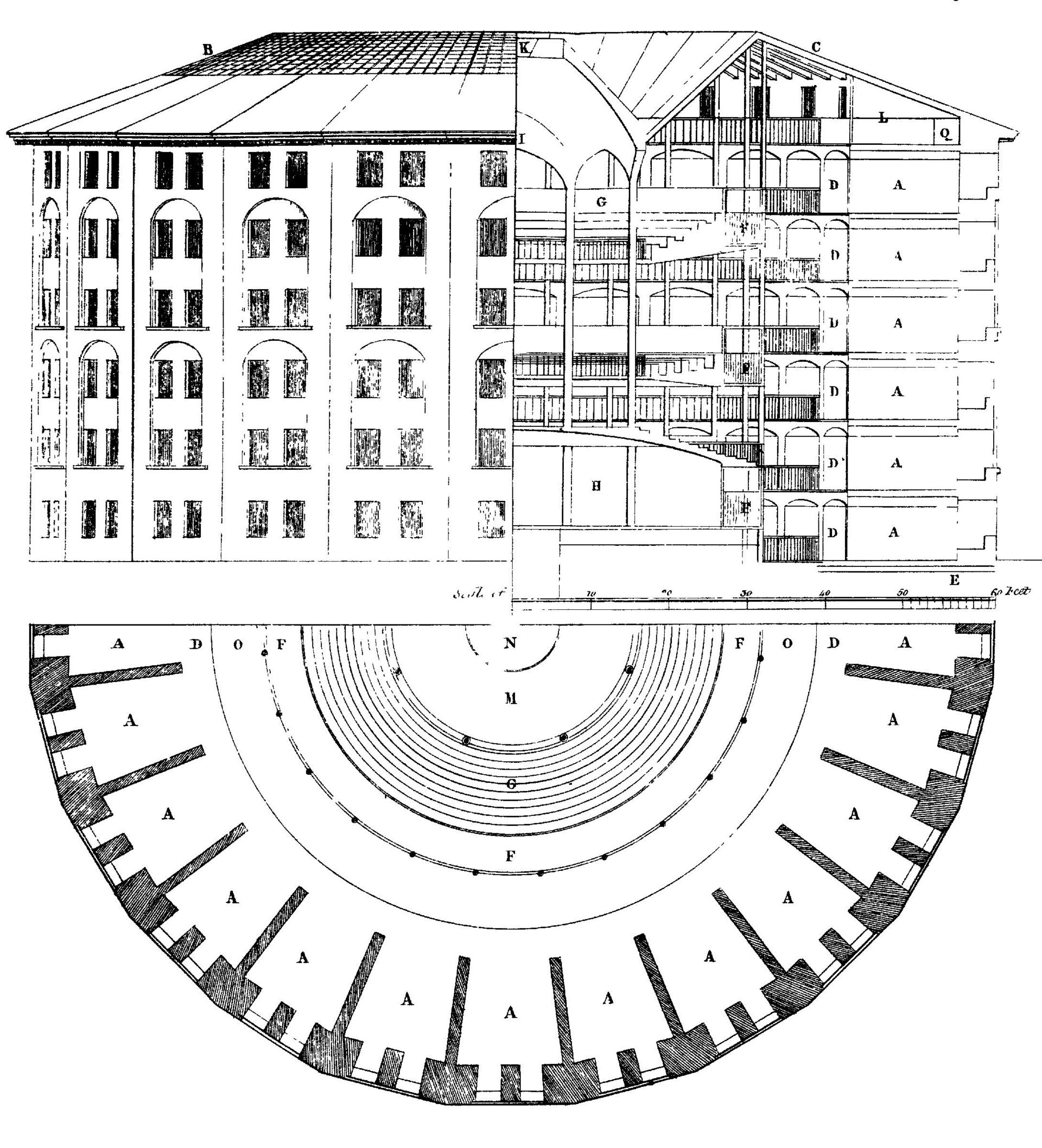
For most of history, confinement was a way station, not a punishment in itself: the accused were held pending trial, debt, or execution. Imprisonment as the standard penalty for crime is a modern invention, arriving with the early nineteenth-century reform movements.
Jeremy Bentham gave the era its defining image. His 1791 design for the Panopticon proposed a circular prison in which a single inspector could observe every inmate without being seen, so that prisoners, never knowing when they were watched, would police themselves.1 Bentham never built it, but the design captured the period’s faith that architecture and surveillance could reform character. The Pennsylvania system, embodied in Philadelphia’s Eastern State Penitentiary, which opened in 1829, pursued the same goal through solitary confinement and enforced reflection, on the theory that isolation would lead the criminal to repentance.
The late twentieth century brought a sharp expansion of imprisonment, above all in the United States, where the prison population rose several-fold after 1970. The increase followed rising crime in the 1960s and 1970s and a turn toward longer, more certain sentences. Supporters credited the policy with the steep crime decline of the 1990s; critics blamed it for mass incarceration and its costs.
The Conservative Position
The conservative case rests first on retribution. Punishment is owed to the wrongdoer because he has earned it and owed to the victim as public recognition of the wrong done. This is distinct from deterrence or rehabilitation: even if a crime could be prevented by other means, conservatives hold that grave offences merit a proportionate penalty as a matter of justice.
The second pillar is protection. James Q. Wilson argued that much crime is committed by a small number of persistent offenders, and that confining them, incapacitation, prevents the crimes they would otherwise commit, whatever the deeper causes of their conduct.2 Wilson criticised the assumption that crime could be addressed only by curing poverty or inequality, contending that swift and certain punishment was both more achievable and more effective. With George Kelling he extended the argument to public order, holding that tolerating minor disorder invites serious crime.3
Conservatives also emphasise moral seriousness toward victims. A justice system that excuses offenders in the name of social theory, they argue, abandons the people crime actually harms, who are disproportionately the poor and vulnerable. At the same time, a growing conservative reform current, organised in efforts such as Right on Crime, argues that prisons should be judged by results: reducing reoffending, supporting work and family ties, and reserving costly confinement for the genuinely dangerous.
Differing Positions
The most influential critique comes from Michel Foucault, whose Discipline and Punish (1975) argued that the prison does not reform but produces a permanent class of delinquents, serving power by managing rather than reducing crime.4 Abolitionists and many reformers draw on this to argue that incarceration is criminogenic: prisons school inmates in crime, sever the family and employment bonds that prevent reoffending, and return people to society more dangerous than before.
A second line of criticism is empirical and fiscal. Mass incarceration, critics argue, has imposed enormous costs for diminishing returns, falling hardest on minority communities, while alternatives such as drug treatment, restorative justice, and supervised release achieve comparable safety at lower human and financial cost.
Conservatives accept much of the reform agenda without conceding the abolitionist premise. They argue that the failures of particular prison systems do not show that punishment is unjust, only that it can be done badly. The dangerous, on this account, must still be confined; the question is how to punish the rest in ways that protect the public and leave room for genuine reform.
References
- Jeremy Bentham, Panopticon; or, The Inspection-House (London, 1791).
- James Q. Wilson, Thinking About Crime (New York: Basic Books, 1975).
- James Q. Wilson and George L. Kelling, “Broken Windows,” The Atlantic (March 1982).
- Michel Foucault, Discipline and Punish: The Birth of the Prison (Paris: Gallimard, 1975).
- [1] Behan, Cormac, and Abigail Stark. 2023. “Introduction.” Springer EBooks, January, 1–10. doi:https://doi.org/10.1007/978-3-031-09301-2_1.
- [2] Halley, Catherine. 2022. “Rethinking Prison as a Deterrent to Future Crime.” JSTOR Daily. July 18. https://daily.jstor.org/rethinking-prison-as-a-deterrent-to-future-crime/.
You've read articles over the past year
Will you support conservative education?
A gift of any amount helps keep unique explanatory journalism free for all, and
supports our mission to help everyone understand the world, regardless of their
ability to pay.One-time contributors join our community of givers and will be kept
up to date on the journalism that you help keep free.

Westernization
Westernization is the adoption by non-Western societies of institutions, technologies, laws, manners and habits of mind that originated in Western Europe and its colonial offshoots....
War Crime
A war crime is a serious violation of the law of armed conflict for which an individual bears personal criminal responsibility. The category covers the...

Voter ID Laws
Voter identification laws require a person presenting to vote to prove who they are, usually by producing a government-issued document. The requirement is unremarkable across...

Voter Fraud
Voter fraud is the deliberate corruption of an election by unlawful means: impersonating another voter, casting ballots in the name of the dead or the...