
Print
Cite
Feedback
Share
The separation of powers divides government into distinct branches, legislative, executive, and judicial, so that no single authority can make, enforce, and judge the law at once. Conservatives prize it as the structural safeguard of liberty: a design that pits power against power and forces ambition to check ambition, rather than trusting the good intentions of rulers. Where the rule of law protects freedom in principle, the separation of powers is the machinery that makes the protection hold.
For the conservative, this arrangement is not a procedural nicety but the central defence against tyranny. Concentrated power corrupts and overreaches regardless of who holds it, so liberty depends less on choosing good rulers than on building institutions that constrain bad ones.
Key Takeaways
- The doctrine separates law-making, law-enforcing, and law-judging into independent branches.
- Its modern form was set out by Montesquieu in 1748 and built into the United States Constitution in 1787.
- James Madison defended it in the Federalist Papers as the means by which ambition counters ambition.
- Conservatives see it as the chief barrier against concentrated power and the expanding administrative state.
- Critics argue that strict separation produces gridlock and that fused systems such as Westminster protect liberty just as well.
History And Context
The idea that mixed and divided authority restrains tyranny is ancient. Aristotle described constitutions that balanced the one, the few, and the many; the Greek historian Polybius praised the Roman republic for distributing power among consuls, senate, and people. John Locke, late in the seventeenth century, distinguished the legislative from the executive power and warned against placing both in the same hands.
The doctrine took its decisive modern shape with Montesquieu. In The Spirit of the Laws (1748) he argued that political liberty exists only where the legislative, executive, and judicial powers are held separately, because their union in one person or body extinguishes freedom.1 His study of the English constitution, idealised though it was, became the template for reformers across the Atlantic world.
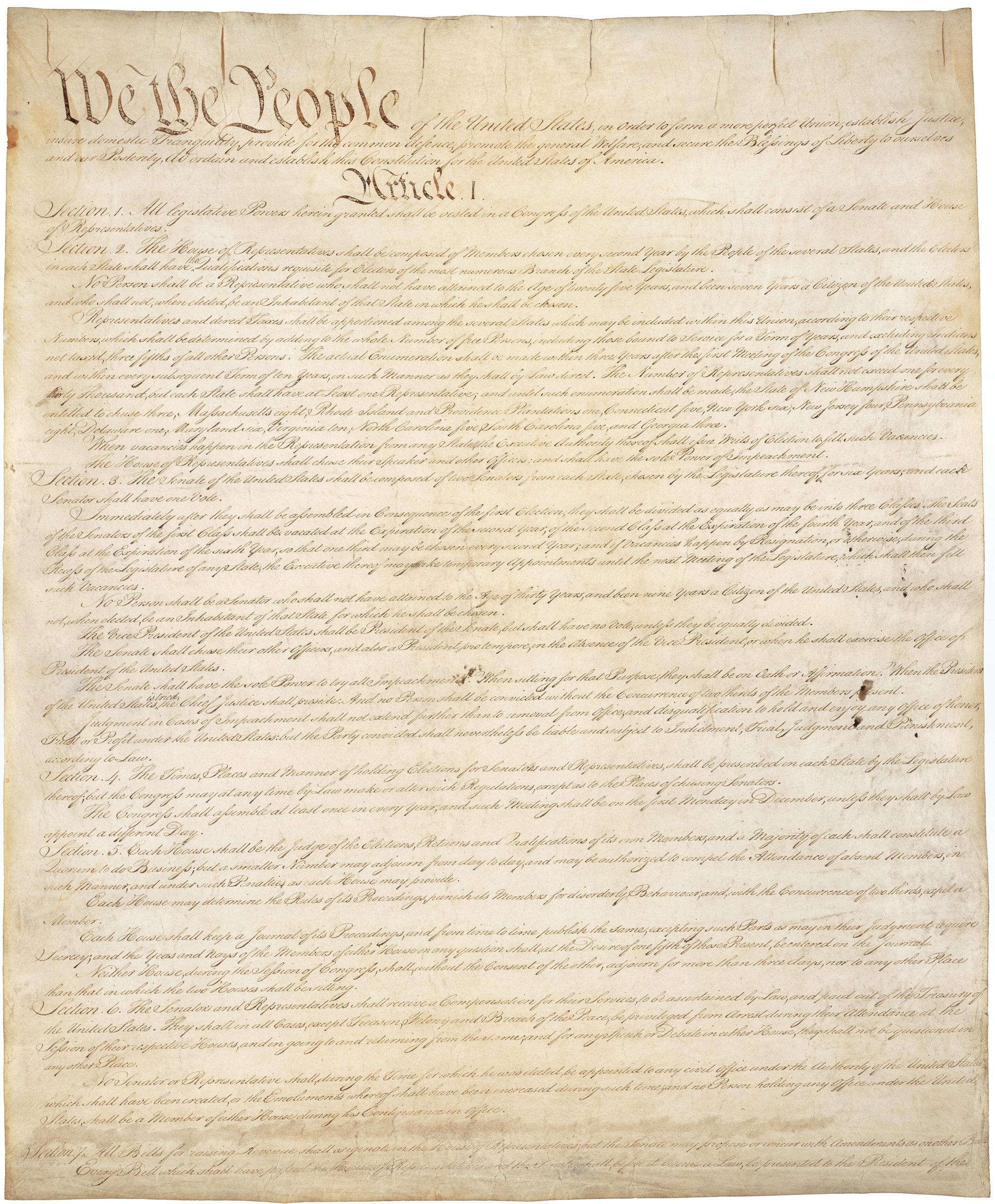
The framers of the Constitution of the United States made the doctrine the backbone of their design in 1787. James Madison, drawing on Montesquieu, defended it directly. In Federalist No. 47 he warned that the accumulation of all powers in the same hands is the very definition of tyranny, and in Federalist No. 51 he argued that the remedy was to give each branch the means and the motive to resist encroachment, so that “ambition must be made to counteract ambition.”2 The resulting system of checks and balances, distinct from a pure separation, became the model studied and copied worldwide.
The Conservative Position
Conservatives value the separation of powers because it embodies a low and realistic view of human nature. Madison’s design assumes that men are not angels and that any branch left unchecked will expand at the expense of the others and of the people. The answer is structural: liberty is protected not by the virtue of officials but by the friction between competing institutions.
This view shapes the contemporary conservative critique of the administrative state. As legislatures delegate broad rule-making authority to executive agencies, conservatives argue, the same hands increasingly write, enforce, and adjudicate the rules, collapsing the very distinction the Constitution was built to preserve. Restoring the separation, on this account, means returning law-making to elected legislatures and confining agencies to enforcement under judicial review.
Friedrich Hayek connected the doctrine to the rule of law itself. He argued that liberty under law requires general rules made in advance and applied by an independent judiciary, a condition that fails when one body both makes and applies the rules to particular cases.3 For conservatives, the separation of powers is therefore inseparable from limited government: it is the device that keeps the state’s coercive power inside knowable bounds.
Differing Positions
The strongest challenge comes from the parliamentary tradition. Walter Bagehot argued in The English Constitution (1867) that Britain’s liberty rested not on separating the executive and legislature but on fusing them through the cabinet, which he called the “efficient secret” of the system.4 Westminster democracies, on this view, protect freedom through responsible government and regular elections without any rigid separation, suggesting the American model is one path to liberty rather than the only one.
A second criticism, associated with Progressive-era reformers such as Woodrow Wilson, holds that strict separation produces deadlock. When branches can block one another, government struggles to act decisively, and accountability blurs because no one branch can be held responsible for outcomes. Critics argue that a fused, parliamentary system delivers clearer mandates and more effective government.
Conservatives answer that the friction critics deplore is the point. Gridlock is the price of preventing hasty or oppressive action, and a government that cannot act quickly is also a government that cannot easily tyrannise. They argue that the durability of constitutional liberty in the United States vindicates the design, whatever its inefficiencies.
References
- Montesquieu, The Spirit of the Laws (1748).
- James Madison, The Federalist, Nos. 47 and 51 (1788).
- F. A. Hayek, The Constitution of Liberty (Chicago: University of Chicago Press, 1960).
- Walter Bagehot, The English Constitution (London: Chapman and Hall, 1867).
- [1] Waldron, Jeremy. 2013. “Separation of Powers in Thought and Practice.” Boston College Law Review 54: 433. https://heinonline.org/HOL/LandingPage?handle=hein.journals/bclr54&div=14&id=&page=.
- [2] Sharp, Malcolm P. 1935. “The Classical American Doctrine of ‘the Separation of Powers.’” The University of Chicago Law Review 2 (3): 385. doi:https://doi.org/10.2307/1596321.
- [3] Robertson, Joseph D., and John W. Buehler. 1976. “The Separation of Powers and the Regulation of the Practive of Law in Oregon.” Willamette Law Journal 13: 273. https://heinonline.org/HOL/LandingPage?handle=hein.journals/willr13&div=18&id=&page=.
You've read articles over the past year
Will you support conservative education?
A gift of any amount helps keep unique explanatory journalism free for all, and
supports our mission to help everyone understand the world, regardless of their
ability to pay.One-time contributors join our community of givers and will be kept
up to date on the journalism that you help keep free.

Westernization
Westernization is the adoption by non-Western societies of institutions, technologies, laws, manners and habits of mind that originated in Western Europe and its colonial offshoots....
War Crime
A war crime is a serious violation of the law of armed conflict for which an individual bears personal criminal responsibility. The category covers the...

Voter ID Laws
Voter identification laws require a person presenting to vote to prove who they are, usually by producing a government-issued document. The requirement is unremarkable across...

Voter Fraud
Voter fraud is the deliberate corruption of an election by unlawful means: impersonating another voter, casting ballots in the name of the dead or the...