
Print
Cite
Feedback
Share
Social Darwinism is the name given to the claim that competitive struggle among individuals, classes, or races is a natural law that public policy should permit to run its course. The label is almost always applied by opponents rather than adopted by adherents, and its modern currency comes from Richard Hofstadter’s Social Darwinism in American Thought, published in 1944 as an indictment of Gilded Age laissez-faire.2
Conservatives reject the doctrine, and they reject it on their own grounds rather than borrowed ones. A politics built on biological struggle treats society as a mechanism for sorting the strong from the weak. Conservatism treats society as an inheritance of obligations — to the aged, the disabled, the unborn, the poor of one’s own parish — that no efficiency argument dissolves. The charge of social Darwinism is nonetheless levelled at free-market conservatives with regularity, and the reply requires distinguishing three separate things that the label runs together.
Key Takeaways
- Herbert Spencer coined “survival of the fittest” in The Principles of Biology in 1864, five years after On the Origin of Species; Darwin adopted the phrase in the fifth edition of 1869.
- Spencer opposed war, imperialism, and state-directed breeding, and advocated private charity — positions difficult to reconcile with the doctrine bearing his name.
- The eugenic programmes of the early twentieth century were projects of state planning, not of laissez-faire, and were championed by progressives as much as by conservatives.
- Historians since Robert Bannister’s 1979 study have argued that Hofstadter’s “social Darwinism” was largely a polemical construction rather than a movement anyone joined.
- Hayek’s account of cultural evolution concerns the selection of rules and traditions across groups, not the biological fitness of persons, and the two arguments should not be conflated.
History And Context
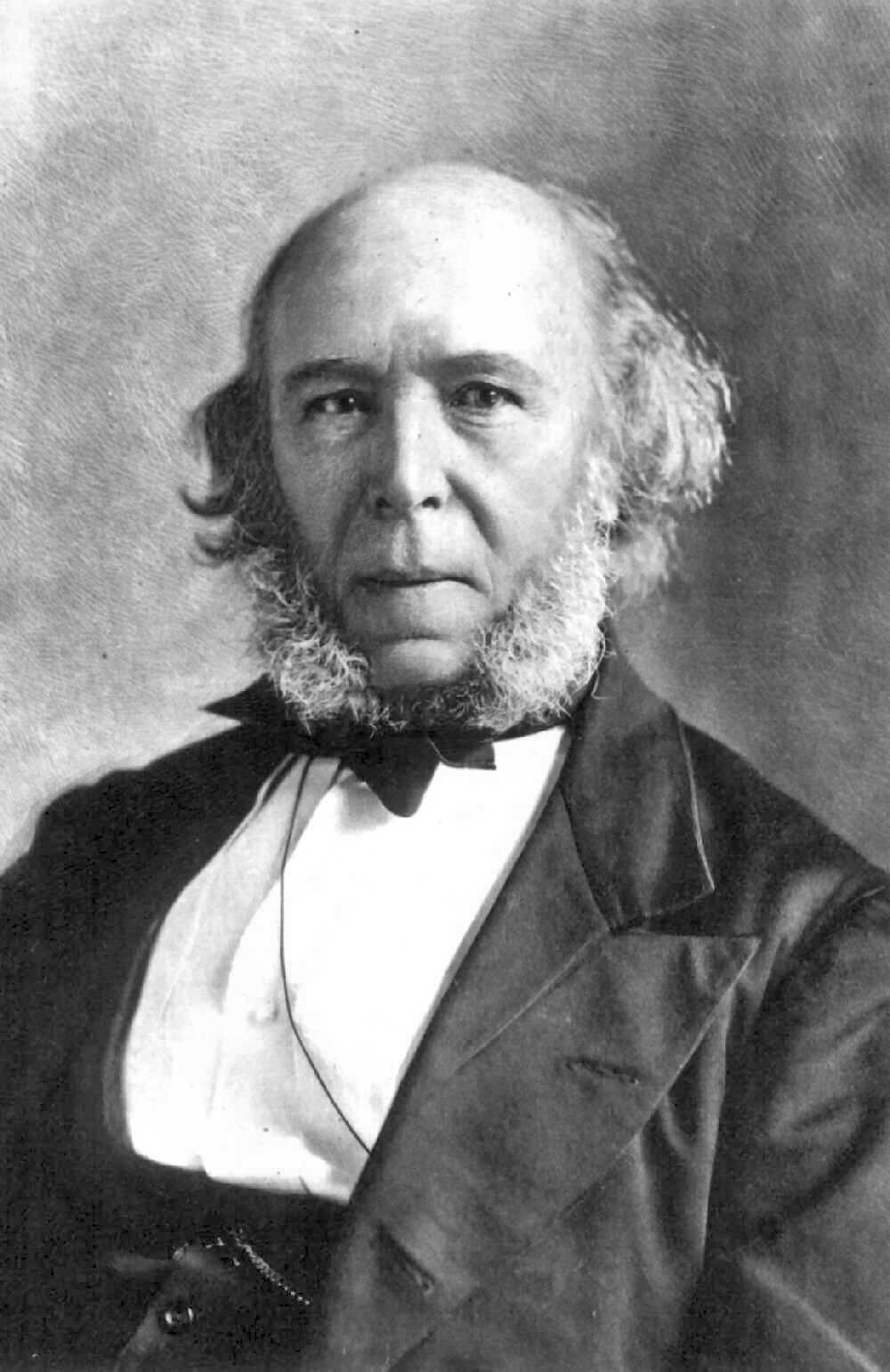
The intellectual sequence runs backwards from what the label implies. Spencer published Social Statics in 1851, eight years before Darwin’s Origin, and his developmental account of society was Lamarckian in structure: he held that habits acquired through discipline would be transmitted and that human beings were adapting toward a condition requiring less coercive government. He then coined “survival of the fittest” in the first volume of The Principles of Biology in 1864, and Darwin borrowed it for the fifth edition of On the Origin of Species in 1869.1 In America, William Graham Sumner argued in What Social Classes Owe to Each Other in 1883 that state transfers between classes rested on no principle a legislature could apply consistently, though he also opposed tariffs, imperial expansion, and the corporate privileges that Gilded Age industry extracted from Washington.
The genuinely dangerous programme came from a different direction. Francis Galton coined “eugenics” in 1883 and proposed the deliberate management of human breeding by expert authority. This was a technocratic project, embraced across the Anglo-American progressive movement as an application of science to social administration. In Buck v. Bell, decided 2 May 1927, the United States Supreme Court upheld compulsory sterilisation by an eight-to-one majority in an opinion by Oliver Wendell Holmes Jr.; some thirty-two American states enacted sterilisation statutes, and Nazi racial hygiene legislation of 1933 drew explicitly on the American model. None of this was laissez-faire. Every element required a state with the authority to classify persons and act on the classification.
Robert Bannister’s Social Darwinism: Science and Myth in Anglo-American Social Thought argued in 1979 that Hofstadter had assembled a school from scattered rhetoric, and that the biological vocabulary of struggle appeared more consistently in the writing of reformers and imperialists than in that of the market liberals Hofstadter targeted.3 The scholarly revision has not dislodged the popular usage.
The Conservative Position
Conservatives make three distinctions the label erases.
The first is between commerce and combat. Market exchange is cooperative: both parties expect to gain, and a firm succeeds by serving customers rather than by destroying rivals. Struggle in the Darwinian sense means differential reproduction under scarcity. A shopkeeper losing custom to a better shop is not a species failing to reproduce, and the analogy misdescribes what a price system does — which is to convey dispersed information about what people want, not to rank human worth.
The second is between the inheritance of rules and the inheritance of genes. Hayek argued that the practices of an extended order — property, contract, the family, honesty in dealing — were not designed by anyone but survived because groups that held them prospered and were imitated.4 The unit of selection is a tradition, transmitted by learning, and open to anyone who adopts it. This is a claim about culture and it carries no implication about the fitness of individuals.
The third is between limited government and indifference. The conservative case against expansive welfare bureaucracy has always assumed that provision for the destitute is a duty, discharged through family, congregation, mutual aid society, and locality, and that these fail when the state displaces them. Burke’s little platoons, Chesterton’s defence of the poor family against the reforming expert, and Nisbet’s account of intermediate institutions form a continuous line of argument that has nothing to do with letting the weak go under. Russell Kirk’s canons of conservative thought begin with belief in a transcendent moral order and include affection for the variety and mystery of human existence; a doctrine that grades persons by fitness is incompatible with both.
The theological point sits beneath all three. A tradition that holds each person to bear the image of God cannot hold that the weak exist to be selected out. The historic conservative institutions — the almshouse, the friendly society, the parish relief, the hospital foundation — were built by people who believed exactly that.
Differing Positions
Critics reply that the distinction between doctrine and effect is convenient. If a policy programme reduces income support, medical provision, and housing assistance, the practical result is a harsher sorting of outcomes by market position, and disclaiming the biological vocabulary changes nothing about who is left without a roof. On this account social Darwinism describes a consequence rather than a creed, and the absence of anyone willing to own the label is not evidence that no one implements it.
A second line notes that the language of natural hierarchy has recurred within the right — in the racial theories of the interwar period, in restrictionist immigration arguments of the 1920s, and in more recent hereditarian claims about group differences in ability. Conservatives who repudiate social Darwinism carry a burden to police that boundary rather than to assert it, and the historical record of enforcement is uneven.
A third holds that Hofstadter’s category, whatever its scholarly defects, captured something real about how Gilded Age industrialists justified themselves in public, and that the revisionist literature corrects the intellectual history without answering the political charge.
References
- Herbert Spencer, The Principles of Biology, vol. 1 (Williams and Norgate, 1864).
- Richard Hofstadter, Social Darwinism in American Thought (University of Pennsylvania Press, 1944).
- Robert C. Bannister, Social Darwinism: Science and Myth in Anglo-American Social Thought (Temple University Press, 1979).
- F. A. Hayek, Law, Legislation and Liberty, vol. 3, The Political Order of a Free People (University of Chicago Press, 1979).
You've read articles over the past year
Will you support conservative education?
A gift of any amount helps keep unique explanatory journalism free for all, and
supports our mission to help everyone understand the world, regardless of their
ability to pay.One-time contributors join our community of givers and will be kept
up to date on the journalism that you help keep free.

Westernization
Westernization is the adoption by non-Western societies of institutions, technologies, laws, manners and habits of mind that originated in Western Europe and its colonial offshoots....
War Crime
A war crime is a serious violation of the law of armed conflict for which an individual bears personal criminal responsibility. The category covers the...

Voter ID Laws
Voter identification laws require a person presenting to vote to prove who they are, usually by producing a government-issued document. The requirement is unremarkable across...

Voter Fraud
Voter fraud is the deliberate corruption of an election by unlawful means: impersonating another voter, casting ballots in the name of the dead or the...