
Print
Cite
Feedback
Share
Introduction
Stanley Baldwin, 1st Earl Baldwin of Bewdley (1867-1947), was three-time Prime Minister of the United Kingdom in the period between World Wars I and II and the father of the ‘One Nation’ Conservative tradition. Instrumental in the downfall of David Lloyd George in 1922, Baldwin became one of the most significant figures in inter-war British politics. Under his leadership, the Conservatives rebranded as the party of national unity and moderate reform in response to political, social and industrial upheaval, becoming the dominant political force in 1930s Britain. Baldwin was married to Lucy Ridsdale, a writer and maternal health activist, with whom he had seven children.
Early career
The son of a Conservative MP, Baldwin was born into a prosperous Worcestershire family of iron manufacturers, and entered Parliament in the 1908 Bewdley by-election, prompted by his father’s death earlier that year. His first years in Parliament were unexceptional, with him largely remaining in the background. Too old to fight in the First World War, Baldwin nevertheless benefitted from the absence of many Conservative MPs., most notably when the Conservatives joined the wartime coalition under David Lloyd George in December 1916 and Baldwin became Parliamentary Private Secretary.
Rise to prominence
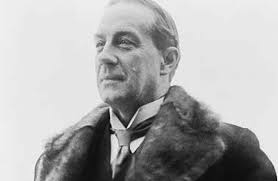
Baldwin’s rise through the junior ministerial ranks gained him a reputation for competence and efficiency, culminating in his post as Financial Secretary to the Treasury in 1917. In March 1921, a superior’s retirement due to ill-health prompted a reshuffle in which Baldwin entered the Cabinet for the first time as President of the Board of Trade. Baldwin quickly became disillusioned by the leadership of Lloyd George and the atmosphere of intrigue that surrounded him: with the coalition government finally crumbling in late 1922 after a succession of crises, Baldwin decided to resign. Austen Chamberlain, Bonar Law’s successor as party leader, and other leading Tories opted to stand by the beleaguered Lloyd George, but there was hostility from the rest of the party.
When Conservative MPs met at the Carlton Club on 19th October, Baldwin declared that he would no longer support the coalition. This meeting, which prompted the creation of the modern 1922 Committee, saw Baldwin describe Lloyd George as a ‘dynamic force’ who had destroyed his own Liberal Party and would surely do so to the Conservatives. This was one of the first of Baldwin’s phrases that entered the British political lexicon: ‘a dynamic force can be a terrible thing’, a crucial foreshadowing of the way Baldwin would govern. The immediate result, on 23rd October 1922, was Baldwin’s installment as Chancellor of the Exchequer and the second man in the Cabinet.
First Term in Office
Party leader Bonar Law’s ill health meant that his premiership only lasted until May 20th,1923, at which point Baldwin was in the prime position to succeed him and begin the first, and shortest, of his terms in office.
At this point, Britain was beset by rising unemployment, agricultural crises, the rise of the Labour Party, and a Conservative Party divided over whether to introduce protectionist policies. Seeking a mandate to fix these issues, Baldwin called an early general election in December 1923 in which he proved a success on the campaign trail; however, the Conservative Party was unprepared for an election and lost its majority in the House of Commons. Rather than resign immediately, Baldwin held on as a minority government until the opening of the new Parliament in January 1924, when the government was defeated in a vote on its legislative program, at which point he resigned and opened the way for the first Labour government.
Second term in office
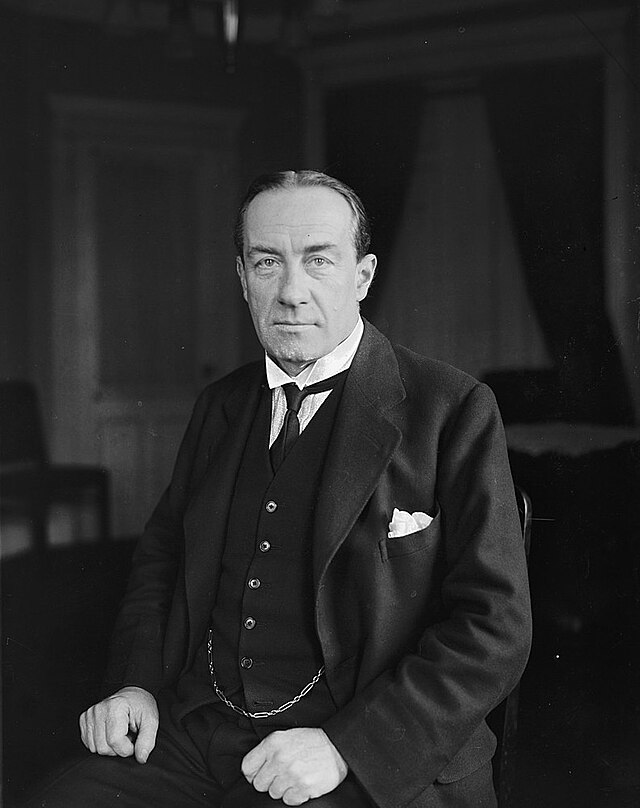
In October 1924, another election was called. Baldwin’s strategy was to maximize the anti-socialist vote by drawing in voters from the collapsing Liberal Party. The result was a landslide for the Conservatives and Baldwin’s return to Downing Street. At a post-election victory rally on 4th December, Baldwin coined the term ‘One Nation’, to describe his brand of paternalistic Conservatism that prioritized social and economic policies to improve the lot of the common man. This second term in office saw solutions for the post-war economic slump and to stabilize Europe: a raft of social reforms, the conclusion of the Locarno Pact in 1925, and the settlement of the Northern Irish border.
These efforts, however, met with limited success and brought many years of industrial unrest to a head in the General Strike of May 1926. One major factor in the government’s success over the strikers was Baldwin’s conciliatory tone and steady leadership that avoided acrimony and extreme measures. The economy did not, however, improve markedly before the end of the Parliament and, as Stuart Ball puts it, the government’s record amounted to ‘a steady diet of worthy but dull measures’. After five years in office, an aura had grown around Baldwin: although his steady leadership had avoided further upheaval, he lacked inspiration and allowed policy to drift. When the Tories unsuccessfully campaigned on the slogan of ‘Safety First’ a second Labour government replaced them in 1929.
Empire Free Trade
With his moderation having failed to secure a second election victory, Baldwin came under pressure from his own party to adopt protectionism wholeheartedly. In this, Baldwin was the beneficiary of circumstances as the onset of the Great Depression enabled him to agree to campaign for a moderate program of tariffs at the next election, but not to embrace a holistic tariff-based program. Successfully galvanizing the party membership, he managed to crush this challenge by securing the election of a supporter at the Westminster St George’s by-election in March 1931 against an ‘Independent Conservative’ candidate backed by the two press barons. It was during this campaign that Baldwin made another of his famous quips when he accused the press of seeking ‘power without responsibility- the prerogative of the harlot through the ages’. Even in defeat, he emerged all the more secure.
National Government
The worsening Great Depression forced Britain’s economy to the brink of collapse in the August of 1931. Matters became so serious that King George V intervened personally by holding a conference in Buckingham Palace on 24th August, at which it was agreed that MacDonald, with a few loyal supporters, would form a coalition government with the Conservatives and Liberals. The King urged Baldwin to agree to join this ‘National’ Government as his patriotic duty; Baldwin reluctantly agreed on the understanding that this would be a temporary arrangement until an election could be held. In the end, this emergency arrangement, in various guises, lasted until 1945. Inevitably, the National Government largely implemented the Conservative program, most obvious in the introduction of tariffs in January 1932 and their extension across the Empire at the Ottawa Conference that August. This arrangement meant that Baldwin was the power behind MacDonald’s throne, which enabled them to maintain the façade of a ‘national’ government, keep crucial Liberal votes, and avoid bringing right-wingers into the Cabinet.
This was also an era dominated by the question of armaments, an issue for which Baldwin became heavily criticized in the Second World War. In November 1932, he infamously added to the general anxiety about the destructive potential of aerial bombing by warning the House of Commons that ‘the bomber will always get through’. This latter issue was the one with which Baldwin became most associated.
The story goes that Baldwin and his colleagues were complicit in a conspiracy of cowardice, wilful naivety, and active malignancy. In Baldwin’s case, the often cited reason was that, after the election of October 1933 saw a pacifist Labour candidate heavily defeat a Conservative, he cynically sought to duck the armaments issue. In fact, Baldwin was the man who outlined Britain’s new strategic reality with the advent of airpower by claiming that Britain’s defensive frontier was no longer the white cliffs of Dover, but now on the Rhine. In 1934, the National Government began to rearm, with Baldwin advocating air power, although slower and more cautiously than some, like Churchill, would have liked.
1935 saw Baldwin becoming prime minister for the third and final time. Baldwin was soon faced with a rapidly developing international crisis when Italy invaded Abyssinia; that autumn, he called a general election to secure a mandate for rearmament. The improved economic situation meant that the government could credibly propose to ramp up its rearmament program, ostensibly to preserve peace through the League of Nations. His third term as prime minister lasted until May of 1937 and saw the introduction of further social reforms, including raising the school leaving age and slum clearances.
Though framed against the rise of both Nazi Germany and Fascist Italy, it was the Abdication Crisis that defined Baldwin’s final period in office. After attempting to dissuade Edward VIII from marrying Wallis Simpson, Baldwin neutralized the issue by presenting it as a constitutional matter as Churchill, amongst others, sought to gain political capital by rallying to the King. Navigating this delicate situation sapped Baldwin’s strength and he retired in May 1937.
Retirement
Baldwin continued to play a small part in political life, supported refugees, and, behind the scenes, encouraged his young protégé Anthony Eden, the Foreign Secretary, when he resigned in opposition to Chamberlain in February 1938. Eden hoped to assume the Baldwinite mantle, but this became anathema when the Second World War broke out and Baldwin’s reputation collapsed. Condemned as one of the leading ‘Guilty Men’ (in July 1940, three journalists under the pseudonym ‘Cato’ published a best-selling pamphlet that accused Baldwin and fourteen other former ministers of being ‘guilty’ of failing to prepare for war), Baldwin experienced vicious press attacks, which became particularly severe after Chamberlain’s death in November 1940.
Legacy
Never accepting the criticism of his last years in office, Baldwin died without much pomp and with his reputation shredded. The man who had dominated interwar British politics and one of the few to serve as prime minister on three separate occasions, he was a shadow of his former self. And yet, while his rise was less flashy and exciting than the heroic story of Churchill or the meteoric rise of Thatcher, Baldwin left a mark on the Conservative Party that endures to this day. The ‘One Nation’ label is entirely a product of Baldwin’s leadership in the 1920s and 1930s. Baldwin’s steady moderation and mastery of the new mass media stabilized British politics and put him at the head of a Conservative Party with more seats than it has held since. He was one of the few prime ministers to retire by choice and, for a time, disproved the adage that all political careers end in failure. Having successfully steered Britain through the potential disaster of the Abdication, he was damned in retirement by forces out of his control, even as he was responsible for transforming a country in the throes of the Depression.
- Baldwin, Stanley. 1926. "On England : and Other Addresses." London: Philip Allan & Co.
- Baldwin, Stanley. 1937."This Torch of Freedom." London: Hodder & Stoughton.
- Baldwin, Stanley. 1938. "Our Inheritance." London: Hodder & Stoughton.
- Ball, Stuart. "Baldwin, Stanley, first Earl Baldwin of Bewdley." Last modified January 20, 2019. Oxford Dictionary of National Bibliography. https://doi.org/10.1093/ref:odnb/30550.
- Earl Baldwin and Stanley Baldwin. 1938. "Service of our lives : last speeches as prime minister / by the Right Honourable Stanley Baldwin, M.P." London: Hodder & Stoughton.
- K. Middlemas & J. Barnes. 1969. "Baldwin: A Biograph." Google Books. London: Weidenfeld and Nicolson.
- Williamson, Philip. 1999."Stanley Baldwin. Conservative Leadership and National Values (British Lives)." London: Cambridge University Press.
You've read articles over the past year
Will you support conservative education?
A gift of any amount helps keep unique explanatory journalism free for all, and
supports our mission to help everyone understand the world, regardless of their
ability to pay.One-time contributors join our community of givers and will be kept
up to date on the journalism that you help keep free.

Milton Friedman
Milton Friedman (1912–2006) was the most consequential economist of the American right in the twentieth century. He rebuilt the case for free markets at a...

Margaret Thatcher
Margaret Thatcher was Prime Minister of the United Kingdom from 4 May 1979 to 28 November 1990, the longest continuous premiership of the twentieth century...

Karl Marx
Karl Marx (1818–1883) was the German philosopher and economist whose theory of class struggle became the most consequential political doctrine of the modern age. With...

Thomas Aquinas
Thomas Aquinas was a thirteenth-century Italian Dominican friar, theologian, and philosopher whose synthesis of Aristotelian philosophy and Christian doctrine became the most influential intellectual framework...