
Print
Cite
Feedback
Share
Conservatives hold that a sovereign nation has both the right and the duty to control who crosses its borders, and that enforcing immigration law is a precondition of self-government rather than an act of cruelty. On this view, the persistence of a large unauthorized population, estimated by the Pew Research Center at roughly 14 million in the United States in 2023, reflects a failure to enforce statutes that Congress itself enacted, and erodes the rule of law, public budgets, and the shared civic culture on which a free society depends.1
The conservative case is not against immigration as such. It is against illegal immigration: entry or residence outside the legal framework a self-governing people has set for itself. Lawful, orderly, skills-weighted admission is consistent with the tradition; an unenforced border is not.
Key Takeaways
- Conservatives treat border control as a core attribute of national sovereignty and the rule of law, not merely a policy preference.
- The economist George Borjas argues that large low-skilled inflows redistribute income from competing native workers to employers and can depress wages at the bottom of the labor market.2
- Samuel Huntington framed the assimilation question, warning that scale, concentration, and linguistic homogeneity could slow incorporation into a shared national identity.3
- US policy history, from IRCA’s 1986 amnesty to the 2006 Secure Fence Act, shows a recurring pattern of legalization promised alongside enforcement that arrived late or not at all.
- Canada and the United Kingdom face parallel debates over asylum backlogs and irregular crossings, though their geography and systems differ.
History And Context
The modern American framework begins with the Immigration Reform and Control Act of 1986 (IRCA, Public Law 99-603), signed by President Ronald Reagan on November 6, 1986. IRCA paired a legalization program, ultimately granting permanent residence to roughly 2.7 million people who had lived unlawfully in the country since before January 1, 1982, or who had performed seasonal agricultural work, with employer sanctions for knowingly hiring unauthorized workers and added border resources.1 Conservatives later treated IRCA as the cautionary template: the amnesty was delivered, but the enforcement and workplace-verification provisions were weakly applied, and the unauthorized population returned to and then exceeded prior levels.
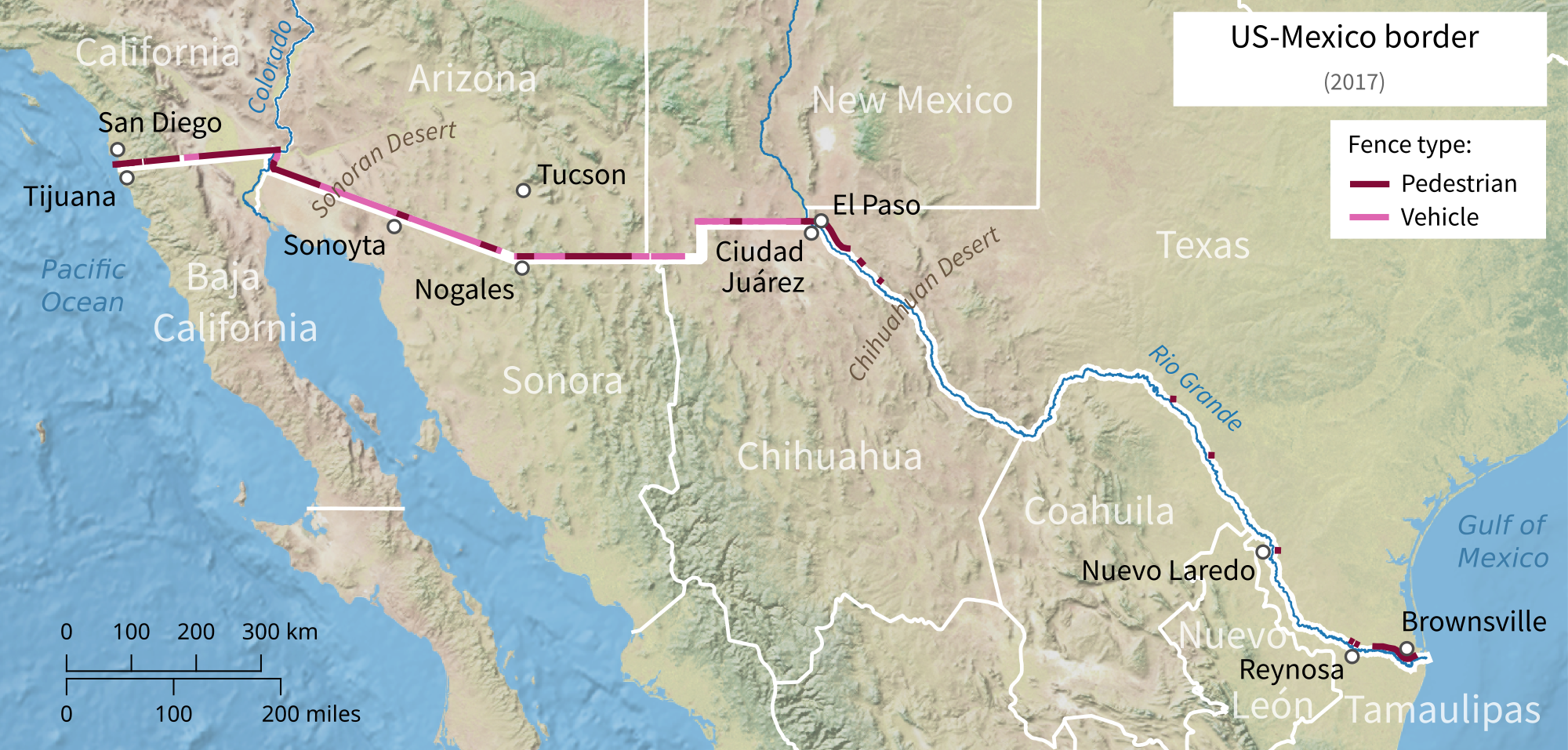
Enforcement-first measures followed. The Secure Fence Act of 2006 (Public Law 109-367), signed by President George W. Bush on October 26, 2006, authorized roughly 700 miles of additional fencing along the southern border, plus vehicle barriers, checkpoints, and surveillance technology.1 Debates over physical barriers, interior enforcement, and the legal status of those brought to the country as children continued through successive administrations. The Pew Research Center estimated the unauthorized population at about 10.5 million in 2021, rising to a record 14 million by 2023.1
The pattern is not unique to the United States. The United Kingdom has debated small-boat Channel crossings and asylum backlogs, and Canada has wrestled with irregular crossings and asylum-claim volumes, though Canada’s lack of a long land border with a poorer state gives it a different enforcement profile.
The Conservative Position
Conservatives advance four connected arguments. The first is rule-of-law: a statute that goes unenforced corrodes respect for law generally, and rewarding unlawful entry with eventual legalization incentivizes more of it. The second is fiscal: low-skilled unauthorized residents, conservatives argue, can draw more in public services, schooling, emergency care, and benefits accessed by citizen children, than they remit in taxes, concentrating costs on particular states and localities.
The third is labor-market. George Borjas, long regarded as a leading immigration economist, contends in Heaven’s Door (1999) and We Wanted Workers (2016) that large low-skilled inflows function as a redistribution: gains accrue to employers and consumers of immigrant-provided services, while the workers who most directly compete, including earlier immigrants and the native-born without a high-school diploma, see downward wage pressure.2 The fourth is assimilation. Samuel Huntington, in Who Are We? (2004), argued that the scale, geographic concentration, and linguistic homogeneity of contemporary immigration could slow incorporation into a common American identity built on English and Anglo-Protestant civic norms.3 Conservatives draw from this a preference for controlled, lawful inflows that the receiving society can absorb.
Differing Positions
The strongest opposing case grants the premise of lawful order but reaches different conclusions. Most economists dispute the size of Borjas’s wage effects, holding that immigrants and native workers are often complements rather than substitutes, that immigration expands demand and entrepreneurship, and that the long-run fiscal picture, especially for the children of immigrants, is positive. Empirical work on assimilation has challenged Huntington directly: studies find that Hispanic immigrants shift to English rapidly by the second generation, that a clear majority reject a purely ethnic identification, and that patriotic attachment grows across generations rather than fading.3
On law, critics argue that an enforcement-only posture ignores the role of US demand for labor in driving migration, and that humane policy requires legal pathways proportionate to that demand, plus relief for long-settled residents and those brought as children. The disagreement, at its most serious, is less about whether borders should exist than about how generous the lawful channels should be and how to treat those already present.
References
- Immigration Reform and Control Act of 1986, Public Law 99-603, 100 Stat. 3359; Secure Fence Act of 2006, Public Law 109-367, 120 Stat. 2638.
- George J. Borjas, We Wanted Workers: Unraveling the Immigration Narrative (W. W. Norton, 2016), p. 9.
- Samuel P. Huntington, Who Are We? The Challenges to America’s National Identity (Simon & Schuster, 2004), p. 221.
- George J. Borjas, Heaven’s Door: Immigration Policy and the American Economy (Princeton University Press, 1999), p. 87.
You've read articles over the past year
Will you support conservative education?
A gift of any amount helps keep unique explanatory journalism free for all, and
supports our mission to help everyone understand the world, regardless of their
ability to pay.One-time contributors join our community of givers and will be kept
up to date on the journalism that you help keep free.

Woman’s Rights
Woman's rights denotes the body of legal and political claims asserting equal standing for women in property, contract, suffrage, education, employment, and family law. In...

White Privilege
White privilege is the claim that people classified as white receive unearned advantages in societies with a history of racial hierarchy, and that these advantages...

Torture
Torture is the deliberate infliction of severe pain on a person held in custody, for confession, information, punishment, or intimidation. European law abolished it as...

Social Security
Social Security is the United States' federal old-age, survivors, and disability insurance program, financed by a dedicated payroll tax and administered by the Social Security...