
Print
Cite
Feedback
Share
Social Security is the United States’ federal old-age, survivors, and disability insurance program, financed by a dedicated payroll tax and administered by the Social Security Administration. Enacted in 1935 as the centerpiece of Franklin Roosevelt’s New Deal, it pays benefits to retired and disabled workers and their dependents, drawing on contributions credited to two trust funds.
The program is the largest single line in the federal budget and the principal source of income for most American retirees. Its long-term financing is the subject of a recurring policy argument: the combined trust funds are projected to deplete within roughly a decade, after which incoming taxes would cover only a portion of scheduled benefits. Conservatives have pressed for structural reform; their opponents defend the existing benefit promise.
Key Takeaways
- Social Security was created by the Social Security Act of August 14, 1935, and now operates through the Old-Age and Survivors Insurance (OASI) and Disability Insurance (DI) trust funds.
- The 1983 Greenspan Commission produced the last major bipartisan rescue, raising the retirement age and taxing benefits to restore solvency.
- The 2024 OASDI Trustees Report projects the combined trust funds depleting in 2035, after which payroll income would cover about 83 percent of scheduled benefits.1
- Conservatives favor structural fixes, a higher retirement age, means-testing, slower benefit growth, and personal accounts, over tax increases alone.
- George W. Bush’s 2005 push for personal accounts collapsed politically, shaping every reform debate since.
History And Context
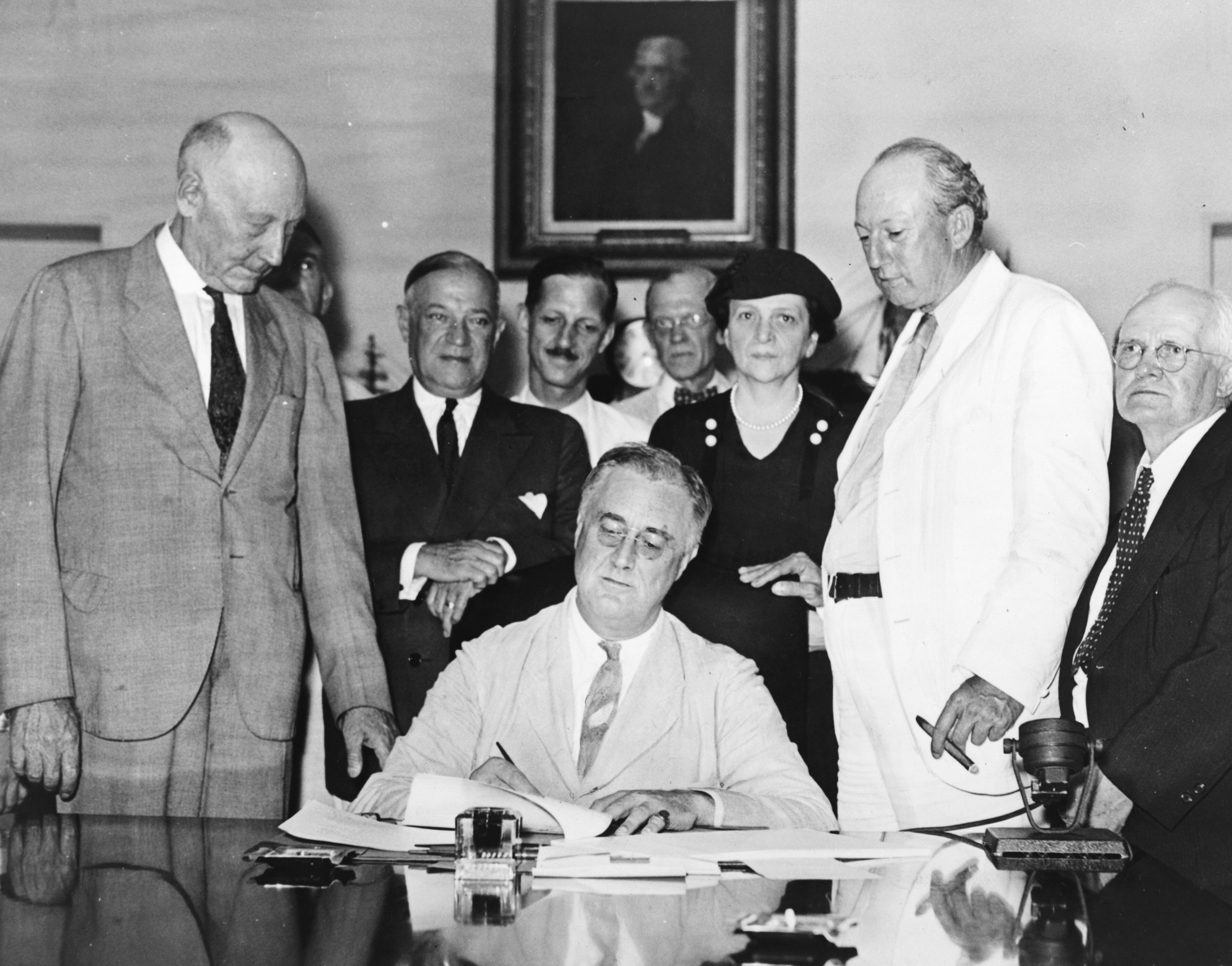
President Roosevelt signed the Social Security Act on August 14, 1935. The bill emerged from the President’s Committee on Economic Security, chaired by Labor Secretary Frances Perkins, and established a contributory old-age benefit funded by a payroll tax on workers and employers.2 The program was designed as social insurance rather than welfare: workers earned benefits through their own contributions, a structure conservatives and progressives alike treated as central to its legitimacy.
The system grew through the postwar decades, adding survivors’ benefits, disability insurance in 1956, and automatic cost-of-living adjustments in 1972. By the early 1980s it faced a financing crisis. Projections in 1982 showed the trust fund unable to pay full benefits as early as 1983. Congress and President Reagan created the National Commission on Social Security Reform, chaired by economist Alan Greenspan. Its recommendations became the Social Security Amendments of 1983, which Reagan signed on April 20, 1983. The law accelerated scheduled payroll-tax increases, taxed benefits for higher-income recipients, brought new federal employees into the system, and raised the full retirement age in steps from 65 to 67.3
In February 2005, President George W. Bush made partial privatization the domestic centerpiece of his second term, proposing voluntary personal accounts that would let workers divert part of their payroll tax into invested funds. The plan never reached a floor vote. Public approval of Bush’s handling of the issue fell sharply through the spring, congressional Democrats held firm against it, and Republicans declined to coalesce around a single bill; by late 2005 the effort was abandoned. Since then no comparable structural reform has advanced, and the financing gap has widened as the baby-boom generation has retired.
The Conservative Position
Conservatives generally accept Social Security as a permanent feature of American life but reject the claim that its financing can be sustained without structural change. They point to the arithmetic in the Trustees Reports: a falling ratio of workers to beneficiaries means the program runs a permanent cash deficit, and the trust-fund reserves it draws on are government bonds that must themselves be redeemed out of general revenue. Charles Blahous, a former public trustee of the system, has argued that the trust fund is an accounting device rather than a store of real assets, and that delaying reform raises the eventual cost of any fix.4
The conservative reform menu favors adjustments to the benefit formula over tax increases. Common proposals include raising the full retirement age further to track rising life expectancy, slowing the growth of initial benefits for higher earners through “progressive price indexing,” and means-testing benefits so that the highest-income retirees receive less. Many conservatives continue to favor personal accounts, arguing that ownership would give workers a real asset, improve returns, and reduce dependence on a system they regard as actuarially fragile. The shared premise is that acting sooner allows smaller, phased changes rather than abrupt cuts at the point of depletion.
Differing Positions
Defenders of the current program argue that Social Security is not in crisis but in need of modest, well-understood adjustment. They note that even after the projected depletion date the system would still pay the large majority of scheduled benefits from continuing payroll taxes, and that the shortfall can be closed by raising or eliminating the cap on taxable earnings, which exempts income above an annual threshold. On this view the program’s near-universal coverage and inflation-protected, guaranteed benefit are precisely its strengths, sharply reducing elderly poverty in a way private markets did not before 1935. Critics of privatization argue that personal accounts expose retirees to market risk and administrative costs while doing nothing to close the existing gap, since diverting payroll taxes into accounts removes revenue the program currently needs. They contend the honest fix is more revenue, not benefit cuts that fall on people with little other retirement income.
References
- The 2024 Annual Report of the Board of Trustees of the Federal OASI and DI Trust Funds (U.S. Social Security Administration, 2024), p. 5.
- Edward D. Berkowitz, Robert Ball and the Politics of Social Security (University of Wisconsin Press, 2003), p. 18.
- Paul Light, Artful Work: The Politics of Social Security Reform (Random House, 1985), p. 175.
- Charles Blahous, Social Security: The Unfinished Work (Hoover Institution Press, 2010), p. 112.
You've read articles over the past year
Will you support conservative education?
A gift of any amount helps keep unique explanatory journalism free for all, and
supports our mission to help everyone understand the world, regardless of their
ability to pay.One-time contributors join our community of givers and will be kept
up to date on the journalism that you help keep free.
Woman’s Rights
Woman's rights denotes the body of legal and political claims asserting equal standing for women in property, contract, suffrage, education, employment, and family law. In...

White Privilege
White privilege is the claim that people classified as white receive unearned advantages in societies with a history of racial hierarchy, and that these advantages...

Torture
Torture is the deliberate infliction of severe pain on a person held in custody, for confession, information, punishment, or intimidation. European law abolished it as...

Social Security
Social Security is the United States' federal old-age, survivors, and disability insurance program, financed by a dedicated payroll tax and administered by the Social Security...