
Print
Cite
Feedback
Share
Key Takeaways
- Free speech is the right to express thoughts and opinions without any government restrictions.
- Conservatives value free speech pointing to the importance of protecting individual liberty and arguing against authoritarianism, political correctness, and hate speech laws.
- Conservatives emphasize the importance of the exchange of ideas and public debates in making society a better place.
Introduction
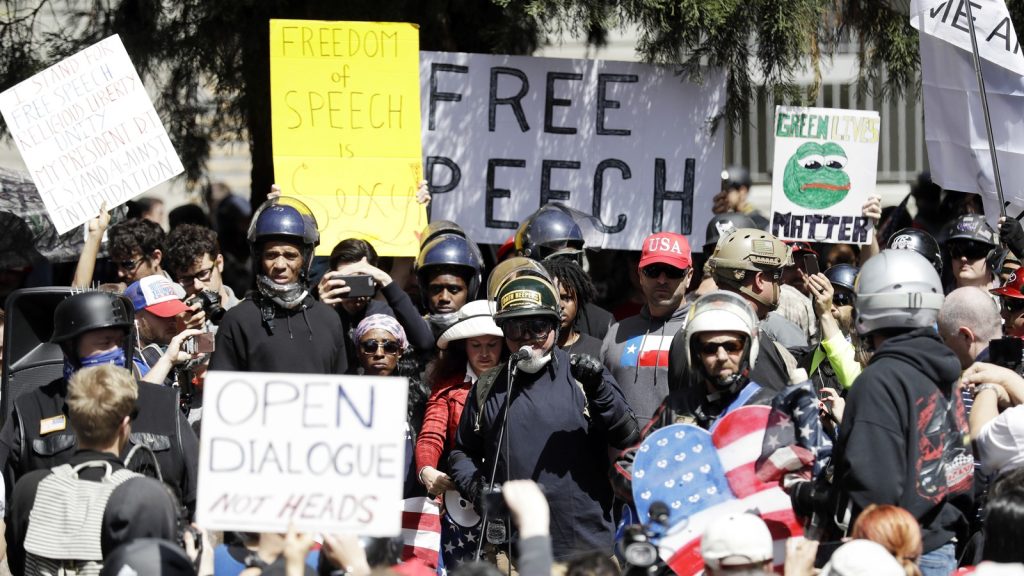
Free speech, a cornerstone of democratic societies, is the principle that individuals possess the inherent right to express their thoughts, opinions, and ideas without censorship or restraint from authorities. Rooted in Enlightenment philosophies and mentioned in various constitutions globally (such as the First Amendment of the United States constitution), free speech pertains not only to spoken word but extends to various modes of expression, including print, art, and digital platforms.[1]
At its core, free speech serves as a bedrock for fostering open discourse, pluralism, and the exchange of different viewpoints. The principle extends beyond government interference, and empowers individuals to challenge prevailing norms, question authority, and advocate for change.
The boundaries of free speech have been continuously debated, trying to find the right balance between preserving individual freedoms and preventing speech that is perceived as encouraging hate or violence. Moreover, its implementation requires a nuanced understanding of the responsibilities that accompany such liberties.
Conservative perspective
There are three main reasons why conservatives value free speech. First, conservatives emphasize the importance of protecting individual liberties in the defense against authoritarianism. Second, conservatives argue against political correctness and hate speech laws. Third, free speech promotes the exchange of ideas and public debates.
Individual liberty and anti-authoritarianism
Conservatives emphasize the inherent right of individuals to express their thoughts and ideas without government interference, arguing that free speech is a crucial aspect of individual liberty, allowing citizens to engage in open discourse and shape their own beliefs. Moreover, conservatives champion constitutional rights, such as the first amendment of the United States constitution, which explicitly protects freedom of speech against any censorship attempts.[2]
Conservatives express concerns about government overreach and the potential for authoritarianism. The argument is that limiting free speech could empower authorities to control public discourse, oppressing dissent and hindering the checks and balances necessary for a healthy democracy, in addition to it infringing on personal freedoms.
Opposing political correctness and hate speech laws
Some conservatives express concerns about political correctness, arguing that it can stifle free speech by discouraging open dialogue and suppressing dissenting opinions. Conservatives see the push for politically correct language as a form of censorship, arguing that it led to the creation of “cancel culture” and to people self-censoring in fear of societal backlash.[3]
Many conservatives oppose laws that regulate hate speech, arguing that there’s no agreement on what is considered as hate speech and such laws can be subjective, leading to the suppression of unpopular or dissenting views. Conservatives, often emphasize the importance of protecting even offensive speech to maintain a truly free and open society. This isn’t to say that conservatives support all speech, for example, slander and serious threats of murder/terrorism should be banned (at least by private institutions) according to many conservatives. However, many modern uses and examples of “hate speech” are seen as political preferences and silencing tactics rather than real examples of dangerous dialogue.
Exchange of ideas
Conservatives liken society to a marketplace of ideas where diverse opinions compete, arguing that free speech enables the robust exchange of competing viewpoints, fostering intellectual diversity and contributing to the discovery of truth. Conservatives assert that such an approach ultimately leads to the best ideas prevailing, leading to the overall improvement of society without banning potentially useful discourse.
- [1] Warburton, Nigel. 2009. “Free Speech,” February. doi:https://doi.org/10.1093/actrade/9780199232352.001.0001.
- [2] Lindner, Nicole M., and Brian A. Nosek. 2009. “Alienable Speech: Ideological Variations in the Application of Free-Speech Principles.” Political Psychology 30 (1): 67–92. https://www.jstor.org/stable/20447185.
- [3] Ekins, Emily. 2017. “The State of Free Speech and Tolerance in America.” Cato Institute. October 31. https://www.cato.org/survey-reports/state-free-speech-tolerance-america#overview.
You've read articles over the past year
Will you support conservative education?
A gift of any amount helps keep unique explanatory journalism free for all, and
supports our mission to help everyone understand the world, regardless of their
ability to pay.One-time contributors join our community of givers and will be kept
up to date on the journalism that you help keep free.
Woman’s Rights
Woman's rights denotes the body of legal and political claims asserting equal standing for women in property, contract, suffrage, education, employment, and family law. In...

White Privilege
White privilege is the claim that people classified as white receive unearned advantages in societies with a history of racial hierarchy, and that these advantages...

Torture
Torture is the deliberate infliction of severe pain on a person held in custody, for confession, information, punishment, or intimidation. European law abolished it as...

Social Security
Social Security is the United States' federal old-age, survivors, and disability insurance program, financed by a dedicated payroll tax and administered by the Social Security...